
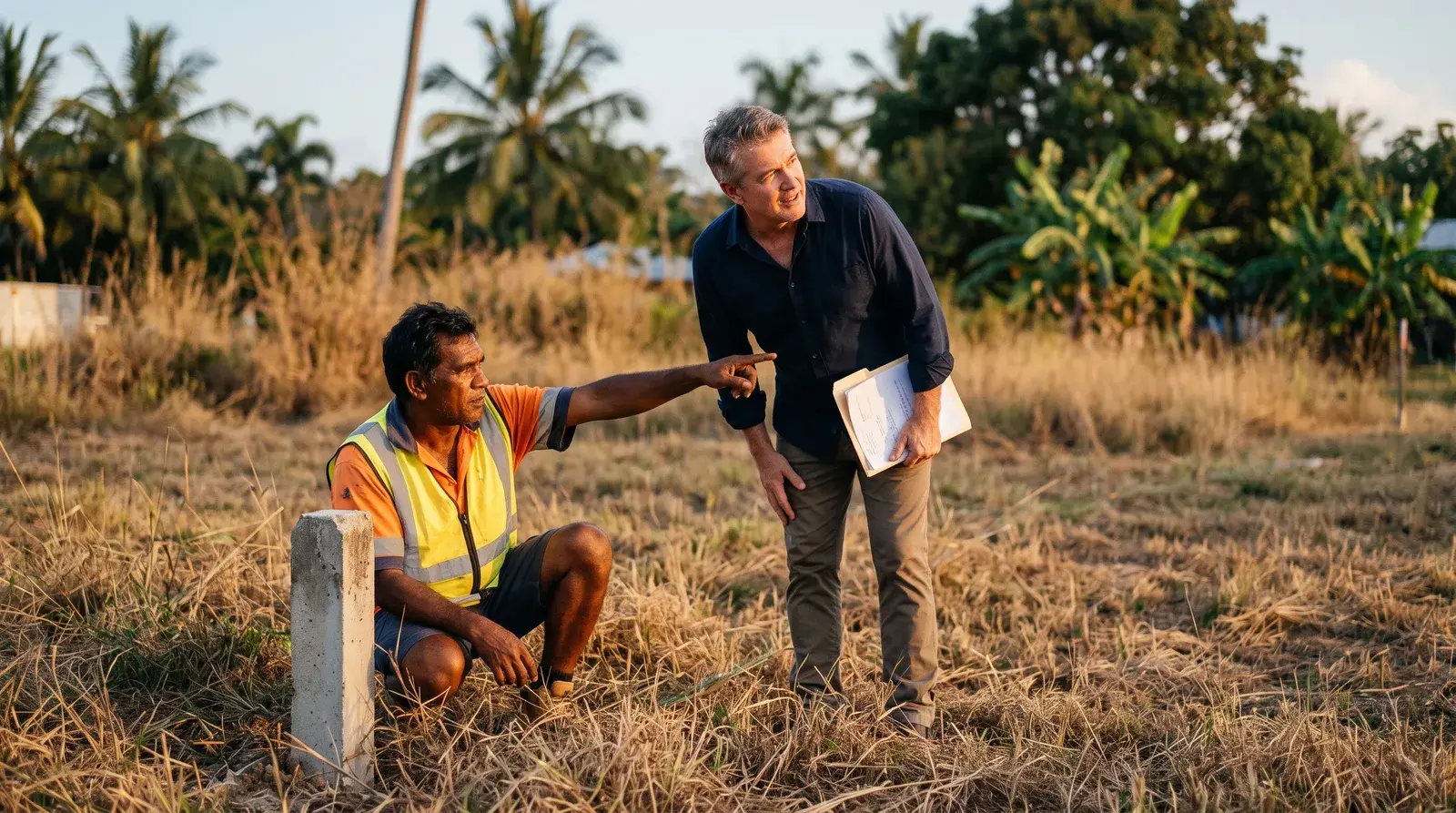
Panama's possessory-rights law does not ask a seller for a deed. It asks for five years of the right kind of occupation. Article 3 of Ley 80 de 2009 recognises the possession of anyone who can show they have exercised "el dominio material con ánimo de dueño, de una manera pacífica e ininterrumpida, por un periodo mayor de cinco años" over national land in island territory and coastal zones: material dominion, as an owner would, peacefully and without interruption, for more than five years. No survey, no finca number, and no entry in the Registro Público are required.
That is the legal foundation under which a great deal of Panama's coastal and island land changes hands. It is called Rights of Possession, or ROP, and confusing it with titled ownership is one of the more expensive mistakes a foreign buyer can make here.
Key Takeaways
- Titled land is registered ownership under a unique finca number in the Registro Público. Rights of Possession is not ownership. It is a legally recognised occupancy claim against land the state still holds.
- The standard is in article 3 of Ley 80 de 2009: material dominion with the intent of an owner, peaceful and uninterrupted, for more than five years. Note what is not in it, whatever you may read elsewhere: there is no requirement that the possession be "public", and no registration requirement at all.
- Article 3 also lists what proves it — habitational, residential, tourism, agricultural, commercial or productive use, plus acts of dominion, documents from national or local police authorities, community witnesses or neighbours. The statute adds that police documents are evidence but are not definitive.
- Some land can never be titled. Article 10 excludes mangroves, indigenous and comarca territories and protected areas; article 1 excludes beach, lake and river shoreline, ports, estuaries, marine-coastal ecosystems and ecological or special reserves. In protected areas, possessory rights are not recognised at all unless they began before the area was declared.
- Island land has a further gate. Article 13 permits island territory to be conveyed only where five conditions hold together, and lets the State declare reserved areas at any time in which no title may be issued, with existing possessors offered a twenty-year renewable use concession instead.
- Qualifying possessors can get title free. Article 5 allows free title over parcels up to 50,000 m² in the adjudicable coastal zone and island territory, with the processing and registration exempt from administrative charges.
- Two Panama-based firms report that titling now typically takes 6 months to 1 year, down from 3 to 5 years before the ANATI-era reforms. That is a firm-reported operating timeline quoting the same industry range, not a published ANATI statistic, and it will vary by parcel.
What titled land actually is
Titled property (propiedad titulada) is registered ownership. It sits in the Registro Público under a unique finca number, the state recognises the claim against any third party, and it can be sold, mortgaged, or insured like real estate anywhere with a functioning land registry. When a broker says a property is "titled," the only thing that confirms it is that finca number pulled directly from the Registro Público. Not a deed shown on a phone. Not a notary's stamp on a private contract. Not the seller's word.
What Rights of Possession actually is
Rights of Possession (derecho posesorio) is a claim to occupy and use land the state still holds, built entirely on the fact of occupation rather than on registration. It traces back to Panama's mid-20th-century land reform, when the government recognised the claims of farmers who worked land without formal title, and it still governs a large share of rural, coastal, and island parcels today. You can build on ROP land, live on it, and sell the claim to someone else. But you do not own it in the registered sense, and neither does the person you buy it from.
What actually proves a possessory claim
This is the part most guides skip, and it is the part your lawyer will work from. Article 3 says the possession is demonstrated by the use itself, and lists the qualifying uses: habitational, residential, tourism, agricultural, commercial or productive. Beyond the use, an applicant can establish the required period through acts demonstrating material dominion, documents issued by national authorities, documents issued by local police authorities, witnesses from the community, or neighbouring landowners.
One sentence in that article is worth knowing before a seller waves paperwork at you: documents issued by police authorities are used as evidence of possession but are not definitive. The Ministerio de Economía y Finanzas may use any means of proof permitted under the Judicial Code to verify possession where it is in doubt. So a seller producing a police certificate and treating the matter as closed has produced something the statute itself says does not close it.
Titled vs. Rights of Possession, side by side
| Titled | Rights of Possession | |
|---|---|---|
| Registered in Registro Público | Yes, with a finca number | No |
| Basis of the claim | State-recognised ownership | More than 5 years of material, peaceful, uninterrupted possession with owner's intent (Ley 80/2009, art. 3) |
| Can be mortgaged | Yes | Generally no. Banks will not lend against an unregistered claim. |
| Title insurance | Available | Rarely available |
| Resale market | Open to any buyer | Narrower. Buyers face the same financing limits you did. |
| Governing framework | Property registration law, Registro Público | Ley 80 de 2009 (coastal and island); Ley 37 de 1962, Agricultural Code (inland) |
| Who administers it | Registro Público | ANATI |
Note the last row of the framework line. Ley 80 governs the coast and the islands. Inland possessory rights run on a different statute, so a guide that explains "Panamanian ROP" purely through Ley 80 is describing only part of the country.
The band nobody can title, and why coastal listings get this wrong
Before the possession question, there is a geography question, and on the coast it disposes of some listings outright.
Ley 80 defines bands measured inland from the high-tide line. On the Pacific coast the ribera de playa runs 22 metres inland; on the Atlantic it is 10 metres. That strip is public domain and is not adjudicable to anyone. Beyond it sits the zona costera adjudicable, running a further 178 metres on the Pacific, and together those make the 200-metre zona costera.
So on the Pacific, nobody owns the first 22 metres of beach, and no length of occupation changes that. A listing implying your title runs to the waterline is wrong as a matter of law rather than optimistic. Within the adjudicable band, land can be held under registered title, under a concession, or as derecho posesorio, which is the choice this page is about.
What can never be titled at all
Two provisions rule land out permanently, whatever its occupation history.
Article 10 puts mangrove zones, indigenous and comarca territories, protected areas, and any other territory subject to legal restrictions on private appropriation outside titling. It adds a rule that catches people out: in protected areas, possessory rights are not recognised at all unless they were initiated before the area was declared protected. Where they were, the holder's use is subject to the applicable environmental rules.
Article 1 sets the scope of titling and carries its own exclusion list: the shoreline of beaches, lakes and rivers, ports, estuaries, marine-coastal ecosystems, indigenous territories, ecological reserves and special reserves, plus other public-domain assets defined by law.
Do you need a broker in Panama?
We'll put you with a licensed one who actually works the area you're reading about. They'll tell you what's for sale, what it's really selling for, and which titles are clean before you commit to anything.
Email or phone, whichever you’d rather. We pass your details to one licensed broker and no one else, and there’s no newsletter.
Know your budget and timeline already? Send those instead and get a shortlist →
Island land: the extra gate in article 13
If the parcel is on an island, a further article applies, and it is the one most likely to defeat a conversion plan. Article 13 provides that island territory "solo podrá ser enajenado", may only be conveyed, where five conditions hold together: possession proven for more than five years; the occupiers' use dedicated to specific national development purposes; the area declared a special development zone; the area not declared strategic or reserved for government programmes; and the adjudication not affecting areas of public use or public domain.
Two of those are government decisions no one in your transaction controls, and one of them requires a positive act by the Executive, done by cabinet decree.
The article then adds the provision that should shape how an island ROP parcel is priced: the State may at any time declare strategic or reserved areas within island territory in which no property titles may be adjudicated. Pre-existing possessory rights are respected, and the State may grant those possessors a use concession for a renewable twenty-year period instead of ownership.
That is the honest downside case for island ROP. Not that the claim is void, but that it may stay a claim, or become a time-limited concession, through a decision made for reasons unconnected to you.
Converting Rights of Possession to title
ROP land can sometimes be converted to full title through ANATI, and sellers routinely present this as a formality that is "already in process." It is not a formality. Based on published process descriptions from Panama-based firms, the conversion generally runs through:
- Documentation review and an engineer's inspection, with a certification report on the parcel
- Public notice of the titling application, historically posted on an official bulletin board and in a national newspaper
- Official appraisal through the government's cadastre and comptroller processes
- Payment to the state, assessed per square meter
- An administrative resolution from ANATI, followed by registration of the resulting title at the Registro Público
Worth knowing at step 4: article 5 of Ley 80 provides for free title over parcels of up to 50,000 square metres in the adjudicable coastal zone, on national land and in island territory, for people who demonstrate possession under the article 3 parameters, with the processing and subsequent registration exempt from any charge imposed by the administrative authorities. In island territory that possibility is subject to article 13. If someone is quoting you a per-square-metre payment, it is fair to ask which route your parcel is on.
Reported timelines run 6 months to 1 year today versus 3 to 5 years under the pre-reform process, according to two Panama-based firms quoting the same industry range. That is not an ANATI-published figure, and it varies by parcel type, location, and whether the possessory history is clean.
Warning. Treat any promise that titling is "already in process" as unverified until you have seen the actual ANATI file number and had your own attorney confirm its status. Not the seller's attorney's summary of it. And confirm first that the parcel is not in one of the article 1 or article 10 excluded categories, because no file number helps land that cannot be titled.
How to check which one you're being offered
Ask for the finca number before you discuss price. If a seller cannot produce one, you are not looking at titled land. Have an attorney pull the entry directly from the Registro Público; do not accept a photocopy or a screenshot as confirmation, because the register itself is the only thing that settles the question. A certificate on a specific finca is inexpensive and short-lived — figures around B/.25 and a 30-day validity circulate widely, though we have not confirmed those against the Registro Público's own published tariff, so treat them as indicative and ask your attorney for the current cost.
Legal. Titling and possessory rights are administered by two separate institutions with separate records: ANATI handles Rights of Possession and the titling process; the Registro Público handles registered ownership, finca numbers, and liens. Confirming one tells you nothing about the other, and a document from one office is not evidence about status at the other.
What buyers actually run into
Broker and law-firm pages describe the legal mechanics fairly consistently. What they describe far less is what goes wrong for the people who buy ROP land, which is where the expat-community accounts diverge from the sales copy:
- Absence is a risk, and the statute does not tell you how much of one. A possessory right is founded on active occupation, and expat-community guidance describes properties left unattended being overtaken by someone else's competing occupation. What Ley 80 actually provides is the acquisition standard: a competing claimant would need to build their own record of more than five years of material, peaceful, uninterrupted possession. The statute does not set out a separate abandonment rule or say what interrupts an existing claim, so the risk is real and its threshold is not published. Anyone quoting you a specific period after which you lose the claim is going beyond the text.
- Undisclosed co-owners and heirs. One published first-person account from an expat couple in Panama describes paying over two years for a property before discovering the seller had concealed other legal heirs, the seller's late father's siblings, who also held a claim. The lesson the writers draw directly: "Don't assume that everyone is telling the truth. Have your lawyer look at a property's history" before final payment, not after. That is one account rather than a measured frequency, but the failure mode it describes is the one most worth designing your diligence around.
- Boundaries are often inconsistent on paper. Because possessory claims accumulate through decades of informal surveying and neighbour agreement rather than a single registered plat, expat-focused ROP guides describe boundary disputes as a routine part of buying this kind of land.
- You cannot mortgage it, and the resale pool is narrower. This is echoed consistently across broker, law-firm, and expat sources: banks will not lend against an unregistered claim, so any future buyer faces the same cash-only constraint you did.
When to walk away
If a seller cannot produce a finca number and cannot explain, with documentation rather than a verbal assurance, exactly why the land is ROP rather than titled, walk away before you pay a deposit. Walk away if the boundaries described on paper don't match what a surveyor finds on the ground, or if any other occupant's claim to the same parcel hasn't been formally and provably resolved. And walk away from any ROP purchase where the seller cannot produce signed waivers from every potential co-owner or heir. The couple in the account above describe getting two years into payments before that surfaced.
Rights of Possession land is not automatically a bad purchase. It is generally cheaper, and plenty of people hold it without incident for years. But it is a fundamentally different asset from titled ownership, with a narrower resale market, no mortgage financing, and a claim that depends on continuous, defensible occupation rather than a government register. If your plan requires financing, a fast resale, or absentee ownership for long stretches, ROP land does not fit that plan regardless of price.
Your next step
You do not have to work this out from a listing photo. Send us the property you are looking at, a link or an address is enough, and we will come back with what the register actually says: whether there is a finca number behind it, whether the land is titled or possessory, and what that means for financing and resale on your timeline. If it is titled and clean, you will know quickly. If it isn't, you will know before you have paid anyone anything. That is what the form below is for, and it costs nothing to ask.
A note on sourcing: the statutory citations on this page are taken from the text of Ley 80 de 2009 itself, read in full. ANATI's own site returned a 403 error throughout this research, so the procedural descriptions of the ANATI conversion process come from Panama law-firm publications rather than from the agency, and are labelled as such above. Have your attorney re-pull the current text for any live transaction.
Frequently asked questions
Is Rights of Possession land legal to buy in Panama?
Yes. Buying and transferring a possessory claim is common and legal. But you're buying the claim itself, not registered ownership, and that distinction is what this guide covers.
What exactly does Ley 80 require to establish a possessory right?
Article 3 requires material dominion exercised with the intent of an owner (con ánimo de dueño), peacefully and without interruption, for more than five years, over national land in island territory and coastal zones. The use itself is the proof, and the article lists habitational, residential, tourism, agricultural, commercial or productive use, supported by acts of dominion, documents from national or local police authorities, community witnesses or neighbouring landowners. The statute expressly says police documents are evidence but are not definitive. You will see the standard quoted elsewhere as requiring "public" possession; that word is not in the article.
Can Rights of Possession land be converted to titled land?
Sometimes. Land in coastal and island zones can potentially be titled under Ley 80 de 2009 if it is not in an excluded category. Article 1 excludes beach, lake and river shoreline, ports, estuaries, marine-coastal ecosystems, indigenous territories and ecological or special reserves; article 10 excludes mangroves, indigenous and comarca territories and protected areas, and provides that in protected areas possessory rights are not recognised at all unless they began before the area was declared. Island parcels face the further conditions in article 13. Confirm eligibility with an attorney before assuming conversion is possible.
Is island land treated differently?
Yes, and more strictly. Article 13 of Ley 80 permits island territory to be conveyed only where five conditions hold together, including that the area has been declared a special development zone and has not been declared strategic or reserved for government programmes. The same article lets the State declare such reserved areas at any time, in which case no titles may be adjudicated there: existing possessory rights are respected, but the holder may be offered a twenty-year renewable use concession rather than ownership. If you are buying on an island, price that possibility in.
Can I get title for free?
Possibly. Article 5 of Ley 80 provides for free title over parcels of up to 50,000 square metres in the adjudicable coastal zone, on national land and in island territory, for people who demonstrate possession under the article 3 parameters, with the processing and registration exempt from charges imposed by administrative authorities. In island territory it remains subject to article 13. If you are being quoted a per-square-metre payment to the state, ask which route your parcel is on.
Can I get a mortgage on Rights of Possession property?
Generally no. Because there's no registered title to secure a lien against, banks will not lend against ROP land in the way they would against a titled finca.
How do I check whether a property is actually titled?
Ask for the finca number and have an independent attorney, not the seller's, pull the entry directly from the Registro Público. Confirming it any other way isn't confirmation. Note that ANATI and the Registro Público keep separate records, so a document from one says nothing about status at the other.
How long does it take to convert Rights of Possession to a title?
Two Panama-based firms report roughly 6 months to 1 year currently, down from a previous 3 to 5 years. Both quote the same industry range, so treat it as one reported figure rather than two independent confirmations. It is not an ANATI-published statistic and will vary by parcel; get a specific estimate from your own attorney once the property's file is reviewed.
What happens if I leave a Rights of Possession property unoccupied for a long time?
It is a real risk and the statute does not quantify it. Because the claim rests on active occupation, expat-community guidance describes unattended properties being overtaken by someone else's occupation. What Ley 80 sets out is the acquisition standard: a competing claimant would need more than five years of material, peaceful, uninterrupted possession of their own. The law does not set a separate abandonment period or say what interrupts an existing claim, so anyone quoting you a specific number of months after which you lose it is going beyond the text. If long absences are part of your plan, this is an argument for titled land.
Does titled land cost more than Rights of Possession land?
Generally, yes. ROP land is commonly priced below comparable titled land, which is part of its appeal and part of why it keeps getting bought despite the risks. This guide did not independently verify a specific price gap; treat any percentage a broker quotes you as their claim, not a sourced figure.
Sources
- Ley 80 de 31 de diciembre de 2009, Gaceta Oficial 26438-B (texto completo) — art. 1 (presupuesto de la titulación y exclusiones), art. 2 (ribera de playa 22 m Pacífico / 10 m Atlántico, zona costera 200 m, zona costera adjudicable 178 m), art. 3 (dominio material con ánimo de dueño, pacífico e ininterrumpido, por más de cinco años, y medios de prueba; los documentos de policía no son definitivos), art. 5 (títulos gratuitos hasta 50,000 m², exonerados de cargos), art. 10 (manglares, territorios indígenas y comarcales y áreas protegidas no son objeto de titulación), art. 13 (condiciones para enajenar el territorio insular; áreas estratégicas o reservadas y concesión de uso por veinte años renovables) — checked 2026-08-22
- Ecolex — registro de la Ley 80 de 31 de diciembre de 2009, Gaceta Oficial Nº 26,438 (ficha bibliográfica) — checked 2026-07
- Abogados.pa — titling process before ANATI (Ley 80/2009, Ley 37/1962). Bufete: descripción de procedimiento, no fuente normativa — checked 2026-07
- RELO Firm — Panama Rights of Possession: process, steps, reported timelines. Bufete — checked 2026-07
- Casa Solution — Title vs. ROP comparison and reported conversion timeframes. Corredor inmobiliario — checked 2026-07
- Kraemer & Kraemer — Panama real estate title process overview. Bufete — checked 2026-07
- Living in Bocas del Toro — "Panama ROP 101" (absence/abandonment, boundary disputes). Fuente comunitaria, no institucional — checked 2026-07
- Living in Panama — relato en primera persona de coherederos no revelados. Un solo caso, no medición de frecuencia — checked 2026-07
Do you need a broker in Panama?
We'll put you with a licensed one who actually works the area you're reading about. They'll tell you what's for sale, what it's really selling for, and which titles are clean before you commit to anything.
Email or phone, whichever you’d rather. We pass your details to one licensed broker and no one else, and there’s no newsletter.
Know your budget and timeline already? Send those instead and get a shortlist →