Panama City is a straightforward city to rent in as a foreigner, and the law starts you off with something useful: a landlord cannot refuse you because of where you are from. Article 4 of Ley 93 de 1973 bans turning a tenant away on grounds of nationality, and that clause holds whatever your rent is. Your lease has to be in writing, has to name the property, the rent and the term, and your landlord has to file a signed copy with MIVIOT, the housing ministry, within five business days. Filing is free. And the deposit has a statutory reference point, one month's rent, held through a state bank rather than in your landlord's own account.
The rest is a process most people get through in two or three weeks. Pick a district, shortlist from the listing sites, take a video tour before you fly, view in person, sign in Spanish with someone on your side reading the contract, and pay on signature rather than before it. This guide walks that sequence in order: what renting costs and how to get a current number, how to search from abroad, what your lease actually covers, what you hand over up front, and how to vet a place before you commit.
Key takeaways
- You cannot be refused for being foreign. Ley 93, Article 4, and it is one of the provisions no decree can strip out.
- Registering your lease with MIVIOT's Dirección General de Arrendamientos is free, and filing it within five business days of signing is the landlord's obligation, not yours.
- The statutory deposit is one month's rent, handled through Banco Nacional de Panamá or the Caja de Ahorros, with disputes over its return going through MIVIOT rather than being settled by the landlord alone. Ley 93, Article 13.
- Your lease term is what the contract says. Ley 93's three-year minimum term applies to rentals of B/.150 a month or less. Above that line, Decreto Ejecutivo 294 of 1994 puts the term under ordinary contract law, so the clause you sign is the one that governs.
- The one official rent figure Panama publishes is a median of B/.300 a month for Provincia de Panamá, from the 2023 census, covering every rented dwelling in the province. It is a floor, not a description of a furnished apartment in a tower.
- Rent before you buy. A year in the city on a lease tells you more about a neighbourhood than any amount of research, and it costs you nothing but rent.
The short answer, question by question
| What you want to know | Where the answer comes from | What it means for you |
|---|---|---|
| How long is the lease? | Whatever your contract says, for anything above B/.150 a month | Read the term and early-exit clauses closely; there is no statutory floor doing that work for you |
| What is the deposit? | Ley 93, Article 13: one month's rent, through a state bank | Ask in writing whether it will be filed under Article 13 |
| Who registers the contract? | The landlord, with MIVIOT, within five business days | Free. Ask for confirmation it was filed |
| Can I be refused as a foreigner? | No. Ley 93, Article 4 | Applies regardless of rent |
| What will it cost? | Official median B/.300 province-wide; current asking prices from listings | Build your own number for the week you move, see below |
| What language is the lease? | Spanish, usually, even in an English-language deal | Have it read by someone who is not renting it to you |
What renting costs, and how to get a real number for your street
Start with what Panama itself publishes. The 2023 national census puts median monthly rent in Provincia de Panamá at B/.300, counting every occupied rented dwelling in the province, from local-standard housing to city apartments. That is a genuine, official number and it is useful as a floor. It is not a description of a furnished two-bedroom with parking in a modern tower, and the clearest evidence of that is the rental law itself: the B/.150 bracket that Ley 93 fully covers has been left untouched since 1994, which is why essentially every lease this guide describes sits above it. Our cost of living guide works through what that census figure measures and how to build a full monthly budget around it.
For the number that actually matters, the asking price on your street in the month you are moving, you can assemble it yourself in about half an hour, and it will beat any table you read anywhere:
- Pick two or three districts rather than searching the whole city. Our Panama City neighbourhood guide compares the districts foreign residents actually choose, from bay-view towers to the walkable streets of Casco.
- Search the main Panamanian classifieds for those districts at your bedroom count, and write down what you see. These are asking prices, not signed rents, so read them as the top of a range that has room in it.
- Check what the price includes. Furnished or empty, parking space, building maintenance fee, water, internet. Two listings at the same headline number can be a couple of hundred balboas apart once those land.
- Look again a week later. Anything still listed after a few weeks has room to negotiate. Anything that vanished in days tells you what that district really clears at.
- Convert asking to budget by adding your first month, your deposit and any building fee, then cross-check the total against the cost of living guide.
Panama is dollarized, so the balboa figures you collect are what you will actually pay, with no exchange-rate layer between the listing and your bank.
If you would rather not do that from another time zone, that is exactly the legwork we do for readers. Tell us the district, the bedroom count and the month, and we will come back with what is currently available and what it is really asking.
Searching from abroad
Most people find their first Panama City apartment before they land, and the sequence that works is boring on purpose.
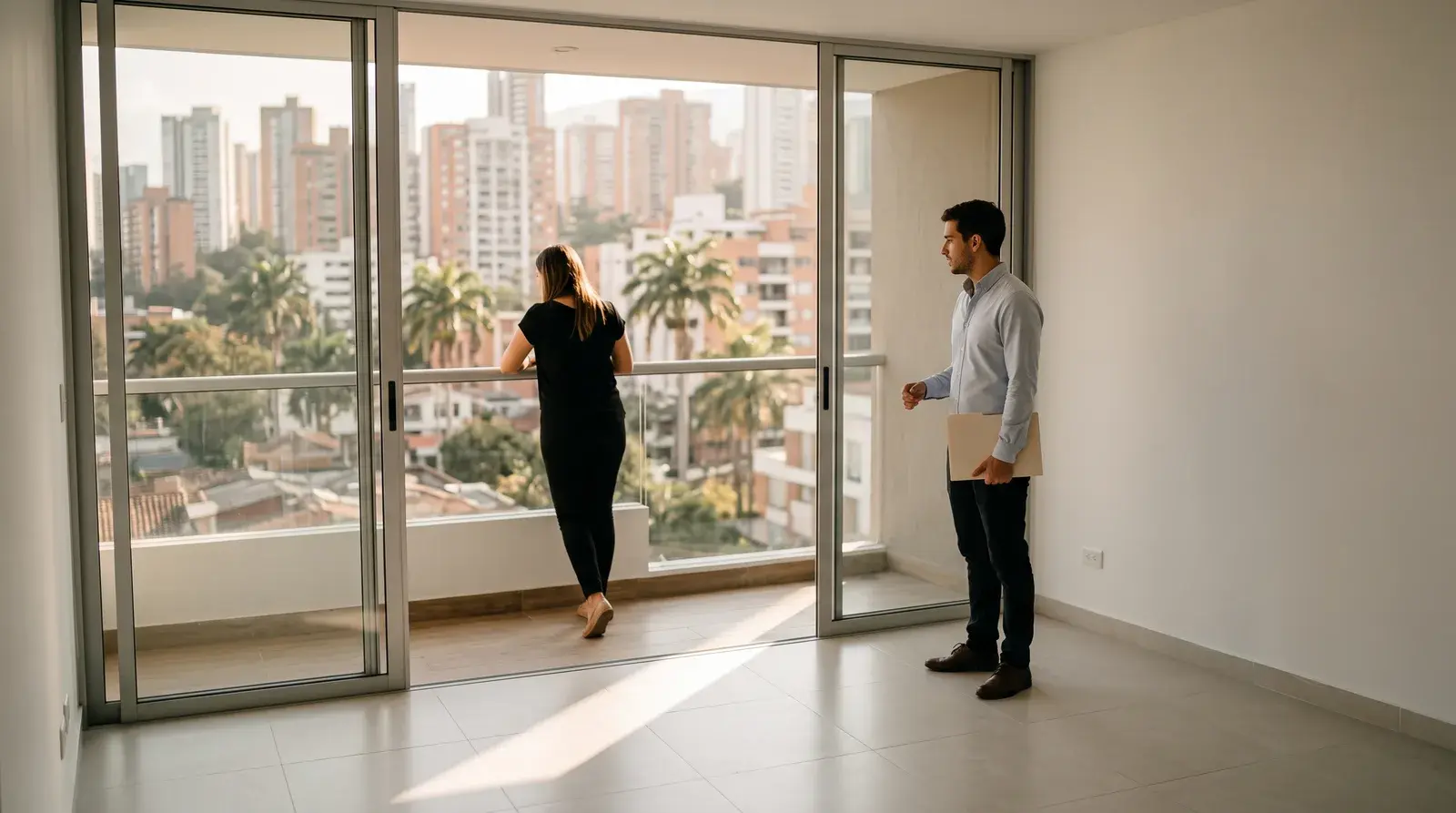
Shortlist from the classifieds and from agents who work your target districts. Message on WhatsApp, which is how the entire market communicates. Ask for a live video walkthrough rather than a recorded one, so you can ask the camera to point at the water pressure, the view from the balcony, and the corridor outside the door. Ask what the building fee covers and whether the unit comes with a parking space, since neither is uniform in Panama City. Then line up three or four viewings in a tight block for your first days on the ground, and keep the first week of your trip in a short-term rental so you are never signing under time pressure.
A landlord or agent who will not do a video call before you commit to a viewing is a mild flag rather than a disqualifier. Some manage a dozen units and simply triage.
Do you need help relocating to Panama?
If you're weighing up the move, a licensed broker who lives here can tell you what the areas are really like to live in, and what your money does in each of them.
Email or phone, whichever you’d rather. We pass your details to one licensed broker and no one else, and there’s no newsletter.
Know your budget and timeline already? Send those instead and get a shortlist →
What your lease covers, and what you pay up front
A Panamanian residential lease has to state the parties, the property's cadastral details, the rent, the term and the intended use of the property. That is Articles 5 and 6 of Ley 93, and it applies whatever your rent. The landlord then files a signed copy with MIVIOT's Dirección General de Arrendamientos within five business days. Registration is free, and unregistered rentals are subject to sanctions, so a landlord who is hesitant about filing is telling you something about how the rest of the tenancy will go.
Up front, expect to hand over your first month's rent and a deposit on signature. The statutory reference point for that deposit is one month's rent under Article 13. Above the B/.150 bracket the specific amount is a contract term, so confirm it in the lease rather than assuming, and confirm the same for any building or move-in fee the administration charges.
The clauses worth your closest attention are the ones that decide what happens when plans change: the term, the notice period for leaving early, who pays for maintenance and repairs, and what renewal looks like. For leases inside Ley 93's bracket, a tenant can exit with 30 calendar days' written notice. For a market-rate apartment, your notice period is whatever the contract states, which is a very good reason to negotiate that clause before signing rather than to discover it later.
Know your rights: what Ley 93 gives you
Ley 93 de 4 de octubre de 1973 is Panama's rental statute, and it is more protective than most people expect: rent paid in arrears rather than in advance, no charge beyond the stated rent, a three-year minimum term binding on the landlord, and a tenant's right to renew for another three years.
Article 1 of the same law lets the Executive Branch move rental brackets out of those substantive provisions and under ordinary contract law, and Decreto Ejecutivo 294 of 7 December 1994 did exactly that for residential rentals above B/.150 a month. That threshold has not moved since. There was one temporary reversal, when Decreto Ejecutivo 145 of 1 May 2020 suspended the exclusion during the COVID-19 national emergency, froze rents and halted most evictions. That suspension was tied to the emergency and ended with it.
What matters for you is that Article 1 also names provisions the Executive cannot exclude by decree. Four of them shape your tenancy directly, no matter what you pay:
- No discrimination (Article 4). A landlord cannot refuse to rent based on nationality, race, marital status, sex, age, colour, political or religious belief, or because you have children.
- A written contract, filed with the government (Articles 5–6). The particulars above, delivered to MIVIOT within five business days. Free to file.
- Basic habitability (Article 8). The property has to meet the hygiene, health and safety conditions the law requires. This is the clause behind a repair request the landlord would rather ignore.
- The deposit mechanism (Article 13). One month's rent, handled through Banco Nacional de Panamá or the Caja de Ahorros rather than sitting in the landlord's account, legally shielded, and released through MIVIOT's Dirección General de Arrendamientos. In practice, market-rate landlords often hold deposits informally, so ask before you pay whether yours will be filed under Article 13 and get the answer in writing. If it will not be, you are relying on the contract and the landlord's word, which is worth knowing on day one rather than at move-out.
Panamanian legal commentary has called Ley 93 overdue for modernisation, and MIVIOT has discussed reform with industry groups. No bill has appeared, so plan around the law as it stands today.
Vetting a place before you sign
Five checks, in the order they come up.
Take a video tour before you commit to an in-person visit. It saves flights, days and a lot of taxi fare.
Ask about flooding history directly, especially for a ground-floor or low-lying unit. The rainy season runs roughly May to November, and low-lying streets in older parts of the city do take on water in heavy rain. A landlord who has held the building for years knows its history, and a vague answer is itself an answer.
Confirm who is filing the contract with MIVIOT, and ask for the deposit to go through the Article 13 mechanism if you want the statutory protection. Most landlords will not raise either point on their own.
Never pay before signing. The contract comes first, then money. A request for a holding fee ahead of a lease is the same warning sign in Panama as anywhere else.
Have the Spanish lease read by someone who is not renting it to you. Even a deal negotiated entirely in English usually produces a Spanish contract, and the early-termination, maintenance and renewal clauses are the ones that reward a second set of eyes.
Is the city the right base for you?
Panama City suits renters who want hospitals, restaurants, an international airport and the deepest choice of apartments in the country, all within a short drive. If you want cooler air, a garden and a smaller community, Boquete and the mountain towns fit better, and if you want the beach with the capital still in reach, the Pacific corridor does. Our guide to the best places to retire in Panama compares eight towns on climate, healthcare and rental supply, and the neighbourhood guide does the same street by street inside the city.
Either way, renting first is the move. A lease lets you test a neighbourhood through a rainy season before any money is committed to buying, and it is the standard path almost every foreign buyer here took first.
Your next step
Tell us your budget, your timeline and the neighbourhood you have in mind, and we will come back with what is actually available right now, what it is asking, and what the lease terms look like. The form below is all it takes, and it costs nothing to ask.
Frequently asked questions
What does it cost to rent an apartment in Panama City?
The only official figure Panama publishes is the 2023 census median for Provincia de Panamá, B/.300 a month, covering every occupied rented dwelling in the province. Treat that as the floor of the market rather than a description of a furnished city apartment. For a real number, search the Panamanian classifieds for two or three districts at your bedroom count in the month you are moving, read what you find as asking prices with room in them, and check what each includes: furniture, parking, building fee, water. Or tell us the district and month and we will send you what is currently available.
How long will my lease run, and can I leave early?
Whatever the contract says. Ley 93's three-year minimum term and forced-renewal right apply to rentals of B/.150 a month or less, and Decreto Ejecutivo 294 of 1994 puts everything above that under ordinary contract law. Inside the statutory bracket a tenant can exit on 30 calendar days' written notice. Above it, your notice period is a contract term, so negotiate the term and early-exit clauses before you sign.
Is my security deposit protected in Panama?
Article 13 of Ley 93 sets a deposit of one month's rent handled through Banco Nacional de Panamá or the Caja de Ahorros rather than held by the landlord, with disputes over its return going through MIVIOT's Dirección General de Arrendamientos. It is one of the provisions no decree can exclude, whatever your rent. Market-rate landlords often hold deposits informally, so ask before you pay whether yours will be filed under Article 13, and get the answer in writing.
Can a landlord refuse to rent to me because I'm a foreigner?
No. Article 4 of Ley 93 prohibits refusing a rental based on nationality, along with race, marital status, sex, age, colour, political or religious belief, or having children. It is one of the provisions that applies regardless of the rent amount.
Does my lease have to be registered with the government?
Yes, and it is the landlord's job. Articles 5 and 6 of Ley 93 require a written contract stating the parties, the property's cadastral details, the rent, the term and the intended use, with a signed copy delivered to MIVIOT's Dirección General de Arrendamientos within five business days. Filing is free and unregistered rentals are subject to sanctions, so ask for confirmation that it was done.
Can I rent an apartment in Panama City before I arrive?
Most people do. Shortlist from the classifieds and from agents working your target districts, message on WhatsApp, and ask for a live video walkthrough so you can direct the camera. Ask what the building fee covers and whether a parking space is included, since neither is standard. Then book three or four viewings in a tight block for your first days and keep that first week in a short-term rental so you never sign under time pressure.
Should I rent before buying in Panama?
Almost always. A year on a lease tells you what a neighbourhood is like through a full rainy season, which is the part no research replaces, and it is the path most foreign buyers here took first. Renting also keeps your options open across the country while you compare the city against the mountains and the beach corridor.
Sources
- Ley 93 de 4 de octubre de 1973 (Ley de Arrendamientos), full text — Artículos 1, 4-16 read directly for scope, exclusion mechanism, anti-discrimination, contract filing, term, and deposit provisions — checked 2026-08-03
- Decreto Ejecutivo 294 de 7 de diciembre de 1994 and Decreto Ejecutivo 7 de 10 de enero de 1995 — exclude residential leases above B/.150/month (and commercial above B/.250/month) from Ley 93, governed by libre contratación; and Decreto Ejecutivo 145 de 1 de mayo de 2020 — temporary COVID-era suspension of that exclusion — checked 2026-08-03
- La Estrella de Panamá — MIVIOT's Dirección General de Arrendamientos confirms contract registration is free and mandatory, with sanctions for unregistered rentals — checked 2026-08-03
- INEC — XII Censo Nacional de Población y VIII de Vivienda 2023, Cuadro 8: median rent by province (reused from the cost of living guide) — checked 2026-08-03
Do you need help relocating to Panama?
If you're weighing up the move, a licensed broker who lives here can tell you what the areas are really like to live in, and what your money does in each of them.
Email or phone, whichever you’d rather. We pass your details to one licensed broker and no one else, and there’s no newsletter.
Know your budget and timeline already? Send those instead and get a shortlist →