Food is one of the genuine pleasures of moving to Panama, and one of the few line items where the country quietly beats what you are used to paying. The Ministerio de Economía y Finanzas prices a fixed basket of foods every month using retail prices collected by INEC, and in March 2026 that basket cost B/.365.88 in the districts of Panamá and San Miguelito, and B/.341.81 in the Resto Urbano covering Colón, David, Chitré, Santiago and six other towns (MEF, checked August 2026). That buys a month of food for a household of 3.5 people. Divide the capital figure by that household size and you get roughly B/.105 per person per month, which is what feeding yourself on Panamanian ingredients actually costs.
Your own trolley will land above that, and the amount above is close to a choice rather than a fact of life. Three decisions do almost all of the work: how much of what you eat is imported, which supermarket chain you default to, and where in the country you live. Get those three right and you eat very well here for very little. This guide walks through each, plus what eating out looks like and how restrictive diets fare outside the capital.
Key takeaways
- The official food basket cost B/.365.88 in the capital and B/.341.81 in the rest of urban Panama in March 2026, for a household of 3.5 people. MEF, Dirección de Análisis Económico y Social, checked August 2026.
- That works out to about B/.105 per person per month, a figure we get by dividing the capital basket by the 3.5-person household it is built for. It is a staples-only floor, not a lifestyle budget.
- The basket is built to meet 2,338.6 kilocalories per person per day from 59 foods, on a shopping list fixed since 2015. Prices are current, the shopping list is not, so treat it as the floor and build upward.
- Import share is the single biggest driver of your bill, ahead of how often you eat out. Food grown and processed in Panama tracks the basket. Food flown in carries freight and duty.
- The chain you default to in your first month sets your baseline for years. Panama's supermarkets are genuinely stratified, from warehouse format to premium import-heavy.
- Location moves the number too. The gap between the two official baskets was about B/.24 in March 2026, and islands and remote areas sit further out again.
The short answer: what your food bill depends on
| If you... | Your grocery bill | Why |
|---|---|---|
| Cook mostly Panamanian ingredients | Lands close to the official basket | Rice, beans, plantain, root vegetables, local chicken and fish are priced in Panamanian shops |
| Keep a few imported comforts | A modest step above it | Coffee habits, one cheese, one wine, and you have bought most of the pleasure for a fraction of the cost |
| Reproduce your home weekly shop | Well above it, with no ceiling | Cereal, imported dairy, specialty flours and familiar brands all carry freight and duty |
| Live in the interior rather than the capital | Below the capital figure | The Resto Urbano basket ran about B/.24 under the capital one in March 2026 |
| Live on an island or far off the road network | Above everything else | Supply arrives by boat or over a long drive |
Groceries: how to shop so the number stays low
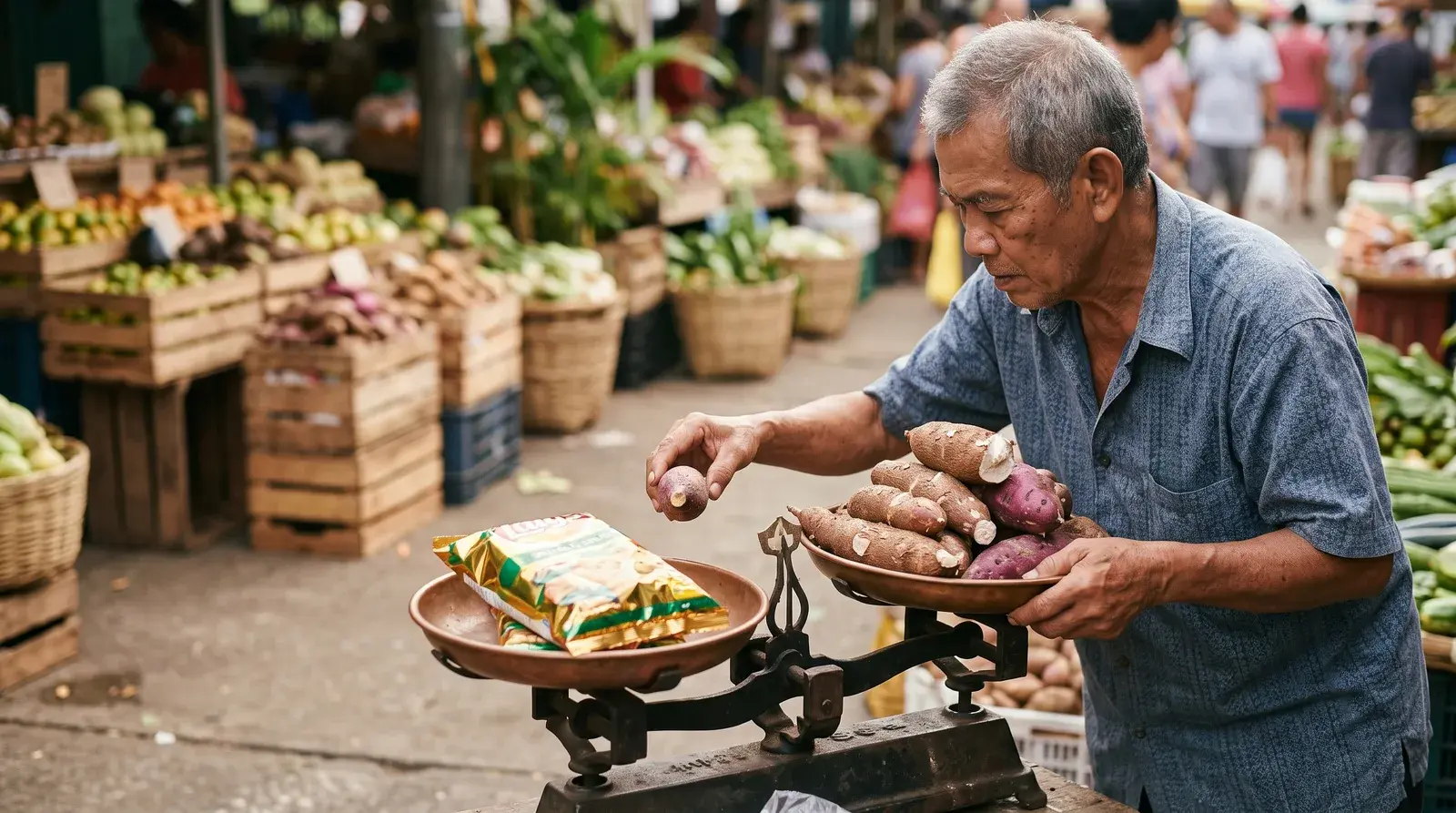
Panama grows and processes a lot of what you will want to eat, and those are the aisles where your money goes furthest. Rice, beans, plantain, yuca and other root vegetables, local chicken, tropical fruit and fish all sit inside the priced basket, which is precisely why a household eating that way tracks the official number so closely.
Import share is the lever. Breakfast cereal, imported cheese, wine, specialty flours and the familiar branded products you grew up with are shipped in, and freight and duty ride along. This is the dominant factor in the gap between a local food bill and an expatriate one, and it is also the one most within your control. The households that eat best for least here are not the ones who gave up everything they liked. They are the ones who buy Panamanian for the bulk of the week and import three or four specific comforts on purpose.
Where you shop is decided in your first month, usually by accident. Panama's chains run from warehouse format to premium import-heavy, and the same product can move a long way in price between them. Most people pick whichever is nearest during the settling-in weeks and never revisit it. Walk two or three before you settle, and split your week: staples and produce at one, the imported handful at another.
Where you live sets the baseline underneath both. The MEF publishes two baskets precisely because the capital and the rest of the country do not cost the same. If you are weighing the interior against Panama City, food is one more item on the interior's side of the ledger, and our cost of living guide puts it next to rent, healthcare and transport so you can see the whole picture at once.
One planning note worth folding in here: do not build a budget by taking the MEF basket and adding a percentage to it. The two baskets are different shopping lists rather than one list scaled, and your own list is different again. Price what you actually intend to eat for a month once you arrive, and you will have a number nobody can publish for you.
Do you need help relocating to Panama?
If you're weighing up the move, a licensed broker who lives here can tell you what the areas are really like to live in, and what your money does in each of them.
Email or phone, whichever you’d rather. We pass your details to one licensed broker and no one else, and there’s no newsletter.
Know your budget and timeline already? Send those instead and get a shortlist →
Eating out: where the value is
Panama City has a real restaurant culture running from market food stalls to internationally ranked kitchens, and we have found no institution that publishes a price series for any of it. What we can tell you is where the value sits, which is the more useful thing anyway.
The cheapest good meal in Panama is a lunch format, not a restaurant type. Comida corriente, the everyday set plate, and neighbourhood comedores, small family-run lunch rooms, serve a fixed midday plate mostly to people working nearby. This is where the gap between local and visitor pricing is at its widest, and it is completely open to you. Eat at the hours Panamanians eat and you get it at their price.
Residential neighbourhoods price differently from tourist districts. The restored colonial quarter carries the premium any beautiful historic centre carries anywhere in the world. Walk a short distance into a residential neighbourhood and the same dishes cost noticeably less. Both are worth doing, for different evenings.
Seafood is the standout. Panama has two coasts and a substantial fishing sector, and fish is the category where quality relative to price departs furthest from what North American and European buyers are used to. If you are moving here and you like to eat fish, this is the part of the food story you will tell people back home.
For live prices, the delivery apps operating in Panama City carry current menus across most of the city, which is a better instrument than anything a guide can freeze into a page.
On the practical side, Panama's Ministerio de Salud is the authority that regulates food handling and inspects establishments, and your own government's travel health guidance covers the rest. Both are free and both are written by people whose job it is.
Dietary constraints
Vegetarian and vegan. Panama City has a functioning scene, and the raw ingredients are excellent and cheap wherever you are. Outside the capital and the established expatriate towns the restaurant options thin out and home cooking becomes the default rather than a choice, which is easier here than most places given the produce.
Gluten-free. Structurally easier than in a wheat-centred cuisine, since rice, plantain and root vegetables carry much of the everyday diet. Specialist substitute products are import items and priced accordingly, so lean on the naturally gluten-free half of the local table rather than the substitute aisle.
Kosher and halal. Panama City has established communities and specialist supply exists. Outside the capital, plan around trips to the city rather than around local availability.
The pattern holds across all three: the capital works without effort, the interior works with planning, and the further you get from Panama City the more your diet is shaped by what the nearest town stocks. If your diet is genuinely restrictive, shop in the specific town for a week before you sign a lease there. That single week is the cheapest insurance in this entire guide.
Which food setup fits you
- You want the lowest food bill available: the interior, cooking Panamanian ingredients, with the Resto Urbano basket as your reference point. Pair it with the towns where budgets stretch furthest.
- You want variety, imports and restaurants on tap: Panama City, where every chain, every cuisine and every specialist supplier is within reach. Start with the neighbourhood guide.
- You want the seafood and the slower pace: the coastal towns, where fish is at its best and the shopping list is shorter. Pedasí and Playa Venao are the ones readers ask about most.
- You have a restrictive diet: base yourself in or near the capital for the first year, then test any interior town for a week before committing.
Your next step
Tell us your budget, your timeline, and how you actually like to eat, whether that means a kitchen worth cooking in, a walkable neighbourhood full of places to try, or a town where the fish comes off the boat that morning. We will come back with a shortlist of areas and specific properties that fit, along with what the weekly shop looks like in each. Use the form below, and it costs nothing to ask.
Frequently asked questions
How much does food cost in Panama?
The official measure is the MEF's canasta básica familiar de alimentos, which was B/.365.88 for Panamá and San Miguelito in March 2026 and B/.341.81 for the Resto Urbano. That covers a month of food for a household of 3.5 people, which works out to roughly B/.105 per person per month on Panamanian ingredients. Treat it as the staples floor and build upward from there: your own bill rises mainly with how much of what you eat is imported.
Why is my grocery bill higher than the government basket?
Almost always import share. Foods grown and processed in Panama track the basket closely, while anything flown or shipped in carries freight and duty on top. A household eating mainly Panamanian ingredients lands near the official figure, and one reproducing a North American or European weekly shop lands well above it. Which supermarket chain you default to is the second factor, and where in the country you live is the third.
How can I eat well in Panama for less?
Buy Panamanian for the bulk of the week and import three or four comforts on purpose rather than by habit. Rice, beans, plantain, root vegetables, local chicken, tropical fruit and fish are the aisles where your money goes furthest. Walk two or three supermarket chains before you settle into one, since Panama's chains run from warehouse format to premium import-heavy. And eat your main meal at midday, when the set-plate format is at its best value.
Where is the best value when eating out in Panama?
The midday set plate. Comida corriente, the everyday fixed plate, and neighbourhood comedores, small family-run lunch rooms, serve mostly to people working nearby and price accordingly. Residential neighbourhoods also cost noticeably less than the restored colonial quarter for the same dishes. Seafood is the category where quality relative to price most exceeds what North American and European buyers expect, given Panama's two coasts and its fishing sector.
Is it cheaper to eat out or cook at home?
It depends on what you cook. If you cook Panamanian ingredients, home is clearly cheaper, since those are exactly the foods the official basket prices so low. If you cook imported ingredients, the midday set plate at a neighbourhood comedor can beat your own kitchen, because it is built on local supply and priced for people working nearby rather than for visitors.
Does food cost the same across Panama?
No, and the government measures the difference. The MEF publishes two baskets because the capital and the rest of the country do not cost the same, with a gap of roughly B/.24 between them in March 2026. The interior runs cheaper, and islands and remote areas run dearer again, since supply arrives by boat or over a long road.
Can I follow a restrictive diet in Panama?
In Panama City, yes, across vegetarian, vegan, gluten-free, kosher and halal, though specialist substitute products are imports and priced as such. Outside the capital and the established expatriate towns it takes more planning and home cooking becomes the default, which the local produce makes easy. If your diet is restrictive, shop in the specific town for a week before signing a lease there.
What does the government food basket actually measure?
It prices a fixed list of 59 foods chosen to meet 2,338.6 kilocalories per person per day for a household of 3.5 people, using retail prices collected by INEC. The prices are updated monthly, but the shopping list itself has been fixed since 2015, so it is best read as a reliable floor for staples rather than as a description of how you will actually shop.
Sources
- MEF, Dirección de Análisis Económico y Social — Canasta Básica Familiar de Alimentos, marzo de 2026 — checked 2026-08-04
- MEF — Canasta Básica, índice de informes mensuales — checked 2026-08-04
Do you need help relocating to Panama?
If you're weighing up the move, a licensed broker who lives here can tell you what the areas are really like to live in, and what your money does in each of them.
Email or phone, whichever you’d rather. We pass your details to one licensed broker and no one else, and there’s no newsletter.
Know your budget and timeline already? Send those instead and get a shortlist →