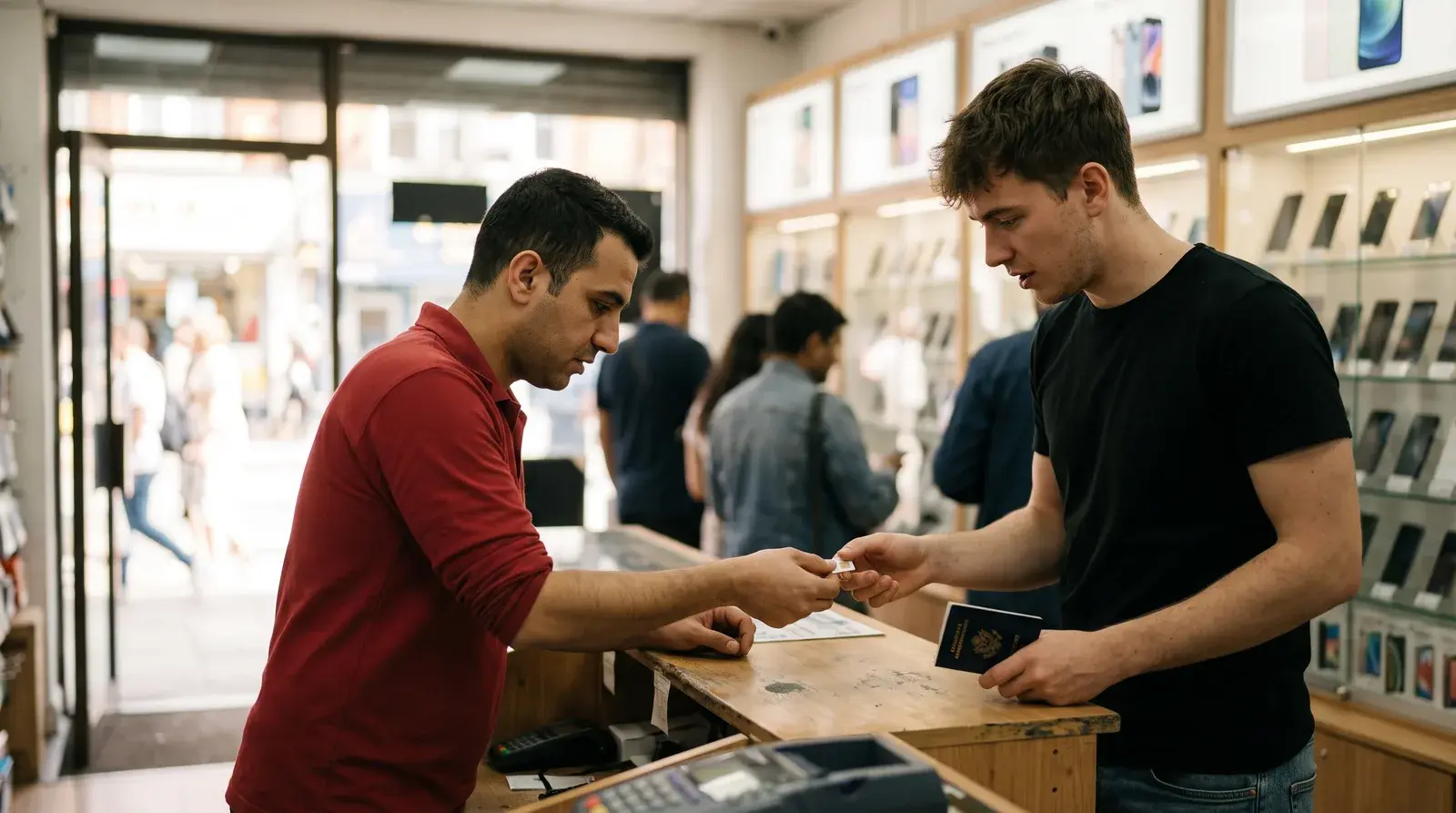
Buying a Panama SIM card is one of the easiest things you will do on arrival. Bring your passport, walk into a Tigo or +Móvil store, register your line at the counter, and pick a data bundle starting at B/.1.50. Ten minutes, and you are connected. Panama closed 2025 with more than 5 million active mobile lines, four out of five of them prepaid, so the counter staff do this all day and the process is well worn (ASEP, checked August 2026).
The one thing worth knowing before you go is the registration rule. Since November 2023 every new prepaid line has to be tied to an ID document, which for a foreigner means your passport. That is the whole catch. The rest of this guide covers who the two carriers are, what each charges right now, and how eSIM works if you would rather skip the physical chip.
Key takeaways
- Panama has two mobile carriers: Tigo and +Móvil. ASEP's count at the close of 2025 put the country at "solo dos (2) operadores activos," with more than 5 million active lines, 79% prepaid and 21% postpaid (ASEP, checked August 2026).
- Bring your passport. ASEP made ID registration mandatory for all new prepaid activations from 15 November 2023, under Resolución AN No. 18397-Telco. Registration is free and takes a few minutes at the counter, and data, SMS and voice stay off until it is done.
- Prepaid pricing starts at B/.1.50 on both networks' own sites, for a one-day bundle. Bundles run from one day to 30 days. See the tables below (tigo.com.pa, masmovilpanama.com, checked August 2026).
- eSIM works on both networks, on iPhone XS and newer plus most current Android models, but issuance runs through a human agent rather than an app checkout.
- ASEP has opened a tender for a third mobile operator in 2026, spectrum in the 3,500 to 3,540 MHz band, 20-year concession. Nothing has been awarded as of this check (ASEP, checked August 2026).
The two carriers, and how it got that way
Your choice on arrival is Tigo or +Móvil. Both sell prepaid bundles, both run nationwide networks, and both have retail stores in every sizeable town plus reseller counters at Tocumen International Airport.
That short list is the result of two decisions in the same handful of years. Millicom bought Cable Onda in December 2018 and Telefónica's Movistar Panamá in February 2019, then unified both under the Tigo brand on 26 August 2020. Separately, Cable & Wireless Panamá (49% owned by the Panamanian state, 49% by Liberty Latin America) bought América Móvil's Claro Panamá operations, cleared ACODECO on 24 March 2022, and completed the roughly $200 million purchase on 1 July 2022. Cable & Wireless sells mobile, home internet and TV under one brand now: +Móvil. The same corporate history shapes your home broadband options, which we cover in the internet providers guide.
The fourth name people remember is Digicel. It launched in Panama in 2010, invested more than $575 million over 14 years, and closed its Panama operations entirely on 20 April 2024 after losing ASEP's tender for its concession. Customers had 30 days to port their numbers, and about 70% did.
One quirk to expect on the shelf: +Móvil's current prepaid terms describe some bundles as including "minutos ilimitados a +Móvil y Claro." That is legacy naming for what is now a single merged network, the same way plenty of Panamanians still say "Cable Onda" for Tigo. If a vendor offers you something branded Claro, just ask which network it runs on.
The registration step, and what to bring
Panama requires identity registration for every new prepaid line, under Resolución AN No. 18397-Telco of 26 April 2023, which implements Ley 51 of 2009 as modified by Ley 13 of 2018. It is an anti-fraud measure: the regulator wanted every active line traceable to a person rather than to nobody at all. It applies to both carriers equally, since it binds every concessionaire.
Here is what actually happens at the counter. You hand over your cédula, the Panamanian national ID, or for a foreigner your passport. An expired document is accepted, because only the ID number is recorded. Staff take a photo of your face for biometric verification and complete a short form. Registration itself is free. Your line switches on immediately afterwards, and until then it carries no data, SMS or voice. One person can register up to 10 prepaid lines, you need to be 18 or over, and a minor's line has to be registered by an adult.
Neither carrier publishes a tourist exception, so plan on the passport even for a four-day trip. Carry the physical booklet rather than a photo of it, and expect the counter to photograph it on the spot.
Do you need help relocating to Panama?
If you're weighing up the move, a licensed broker who lives here can tell you what the areas are really like to live in, and what your money does in each of them.
Email or phone, whichever you’d rather. We pass your details to one licensed broker and no one else, and there’s no newsletter.
Know your budget and timeline already? Send those instead and get a shortlist →
What a prepaid SIM costs right now
Both carriers publish their own prepaid pricing, and they package it differently, so read down the "what's included" column rather than comparing headline prices straight across.
Tigo's Paquetigo bundles (tigo.com.pa, checked August 2026)
| Validity | Price | What's included |
|---|---|---|
| 1 day | B/.1.50 | Unlimited data*, unlimited minutes to Tigo, 100 SMS to Tigo, 20 SMS to other networks |
| 2 days | B/.2.75 | Same |
| 3 days | B/.3.85 | + 30 min to other networks, 500MB to share |
| 5 days | B/.6.00 | + 30 min to other networks, 2GB to share |
| 7 days | B/.7.00 | + 30 min to other networks, 3GB to share |
| 10 days | B/.9.00 | + 60 min to other networks, 2GB to share |
| 15 days | B/.11.50 | + 60 min to other networks, 3GB to share |
| 30 days | B/.22.00 | + 60 min to other networks, 5GB to share |
*"Unlimited data" runs under Tigo's fair-use policy, published separately on its site, so it is not a literally cap-free connection.
+Móvil's Paquetes de Data Prepago (masmovilpanama.com, checked August 2026)
| Validity | Price | What's included |
|---|---|---|
| ~1 day (base tier, no explicit term stated) | B/.1.50 | Unlimited LTE data, 100 min to +Móvil, 100 SMS to +Móvil |
| 3 days | B/.3.50 | Unlimited min to +Móvil, 10 min to other networks, 500MB to share |
| 5 days | B/.5.00 | Unlimited min to +Móvil, 25 min to other networks, 1GB to share |
| 6 days | B/.6.00 | Unlimited min to +Móvil, 25 min to other networks/long distance, 3GB to share |
| 7 days | B/.7.00 | 5G access, unlimited min to +Móvil, 30 min to other networks, 5GB to share |
Treat both tables as a guide to the shape of the market rather than a locked quote. +Móvil's own terms on that page carry a validity window that had already lapsed when we checked in August 2026, on a page still selling those exact bundles, so confirm the live price when you buy.
Neither company publishes a standalone price for the physical chip itself; pricing starts with the first data package. Kiosks and authorized resellers sometimes add a small fee for the card, so ask before you hand over your passport.
eSIM or physical SIM
Both Tigo and +Móvil support eSIM on compatible phones: iPhone XS and newer, plus most recent Samsung, Google Pixel and other current Android models. +Móvil publishes a full compatible-device list on its own site.
The process is agent-assisted rather than self-serve. +Móvil's eSIM FAQ is explicit about it: you request the eSIM through an agent by store visit, phone call or WhatsApp, and that agent assigns your number and plan and emails you a QR code to scan. You can start that conversation before you board if you want the QR waiting when you land. The same passport registration applies whichever format you choose, so an eSIM saves you the physical card and the kiosk queue, not the ID check.
Third-party eSIM resellers such as Airalo and Holafly also sell Panama data eSIMs, riding on these same two underlying networks. They are separate businesses with their own pricing and their own sign-up flow, which we have not audited here.
Where to buy, and a few arrival tips
Both carriers sell prepaid SIMs through their own retail stores, and authorized resellers run counters in Tocumen International Airport's arrivals area. A handful of things smooth the process:
- Check the kiosk hours when you land rather than in advance. Neither carrier publishes airport counter hours on its own site, so if your flight arrives late, plan on buying from a city store the next morning instead.
- Confirm your phone is unlocked before you fly. Whether a US-locked handset will work here depends on your home carrier's unlock policy and your phone's radio bands, and that is a question only your carrier can answer.
- Pick by coverage where you are going, not by brand. There is no published operator-by-operator market-share or speed comparison in Panama, so the useful move is to check each carrier's own coverage map for your specific town, or ask at your hotel or building.
- Buy the short bundle first. Bundles start at one day, which makes testing a network cheap before you commit to a 30-day package.
- Keep the number. A local number makes everything else in Panama easier, from a bank appointment to a WhatsApp message to a property agent, since most business here happens on WhatsApp.
Your next step
A local number is usually the first thing people sort out on a scouting trip, and the second is figuring out which neighbourhood or town they actually want to be in. If Panama is on your list for a rental, a purchase or a full move, tell us your budget, your timeline and roughly when you plan to visit. We will come back with the areas worth your days on the ground and the properties that fit. The form below is the place to start, and asking costs nothing.
Frequently asked questions
Do I need a passport to buy a SIM card in Panama?
Yes, if you are a foreigner. ASEP has required identity registration for every new prepaid line since 15 November 2023, under Resolución AN No. 18397-Telco. Panamanians use a cédula, the national ID; foreigners use a passport, and the document does not need to be current, since only the ID number is recorded. Registration is free, takes a few minutes at the counter, and your line has no data, SMS or voice until it is done.
Can I still buy a Claro SIM card in Panama?
No. Cable & Wireless Panamá completed its acquisition of Claro Panamá's operations on 1 July 2022, after ACODECO's approval, and folded the network into its +Móvil brand. You may still see "Claro" in +Móvil's promotional fine print, which is legacy network naming for what is now one merged network. Buy from Tigo or +Móvil and you are on one of the country's two networks either way.
Is Digicel still an option for a Panama SIM?
No. Digicel closed its Panama operations entirely on 20 April 2024, after losing that year's government concession tender, and gave customers 30 days to port their numbers elsewhere. Your options today are Tigo and +Móvil.
Should I get a physical SIM or an eSIM in Panama?
Both Tigo and +Móvil support eSIM on newer phones, and either saves you a physical card and a kiosk visit. Neither lets you fully self-activate before you land: +Móvil's eSIM process runs through an agent (store, phone or WhatsApp) who assigns your number and emails a QR code, and the same passport registration applies to eSIM as to a physical card. If your phone is not eSIM-compatible, or you would rather not coordinate with an agent, a physical SIM bought at a store or airport counter is the simpler route.
Which is better for a short trip, Tigo or +Móvil?
Both sell prepaid data bundles starting at B/.1.50. Tigo's published tiers run from one day to 30; the +Móvil tiers we could read stop at seven days, so check the term before you buy if you need a month. The more useful question is coverage in the specific town you are heading to, which you can check on each carrier's own coverage tool or by asking locally. Since bundles start at a single day, testing one network before committing to a 30-day package costs almost nothing.
What happens if I don't register my prepaid SIM?
Nothing works. ASEP's rule requires carriers to withhold data, SMS and voice until the registration is complete: cédula or passport, plus a facial photo for biometric verification. Carriers enforce it consistently, and +Móvil's own FAQ states services activate immediately after registration and not before. In practice you register at the counter when you buy, so it is one step rather than an extra errand.
Will Panama get a third mobile carrier?
Possibly, but not yet. ASEP opened a public tender in 2026 for a third mobile operator, reserving spectrum in the 3,500–3,540 MHz band under a 20-year concession, citing the country's more than 5 million active lines as an attractive market. As of this page's last check, no operator has been awarded that concession and the market remains Tigo and +Móvil.
Sources
- ASEP — Asep ratifica que licitación para tercer operador móvil se realizará este año (23 March 2026): only two active mobile operators, 5M+ active lines, 79% prepaid / 21% postpaid at close of 2025 — checked 2026-08-03
- ASEP — Inicia registro de nuevas líneas prepago (15 November 2023): mandatory ID registration for new prepaid lines, Resolución AN No. 18397-Telco of 26 April 2023, Ley 51 of 2009 as modified by Ley 13 of 2018 — checked 2026-08-03
- +Móvil (Cable & Wireless Panamá) — prepaid SIM registration page: cédula/passport requirement, free registration, 18+ only, up to 10 lines per person — checked 2026-08-03
- Tigo Panamá — Paquetigo prepaid data and voice bundle pricing — checked 2026-08-03
- +Móvil (Cable & Wireless Panamá) — Paquetes de Data Prepago pricing — checked 2026-08-03
- +Móvil (Cable & Wireless Panamá) — eSIM activation process, compatible device list, agent-assisted issuance — checked 2026-08-03
- La Prensa Panamá — Digicel Panamá closed operations entirely on 20 April 2024 after losing the concession tender; customers given 30 days to port — checked 2026-08-03
- Liberty Latin America — Cable & Wireless Panamá completes acquisition of América Móvil's Panama (Claro) operations, 1 July 2022, approximately $200 million — checked 2026-08-03
- ACODECO — approval of the Cable & Wireless Panamá acquisition of Claro Panamá, 24 March 2022 — checked 2026-08-03
- Telecompaper — Millicom rebrands Cable Onda as Tigo Panama (Cable Onda stake acquired December 2018, Movistar Panamá acquired February 2019, brands unified 26 August 2020) — checked 2026-08-03
Do you need help relocating to Panama?
If you're weighing up the move, a licensed broker who lives here can tell you what the areas are really like to live in, and what your money does in each of them.
Email or phone, whichever you’d rather. We pass your details to one licensed broker and no one else, and there’s no newsletter.
Know your budget and timeline already? Send those instead and get a shortlist →