Cash in Panama is easier than almost anywhere in the region, and the reason is structural. Every banknote here is a US dollar, every licensed bank sits on one shared ATM network, and the fees are published by the banks themselves in documents you can open and read. A Banco Nacional customer pays B/.1.61 to withdraw cash from any ATM in Panama, their own bank's or anyone else's. A Banco General customer pays nothing inside their own network and B/.1.87 outside it. A Banesco customer gets three free out-of-network withdrawals a month and pays from the fourth.
Those figures come from each bank's tarifario, the published schedule of rates and commissions, and they already include the 7% ITBMS that Panamanian law puts on banking commissions. Here is what they mean for your first week, your first withdrawal on a card issued abroad, and the one rule at the airport that carries a real penalty.
Key takeaways
- Published local ATM fees run from B/.0 to B/.1.87 per withdrawal, ITBMS included. Tarifarios of Banco Nacional de Panamá, Banco General and Banesco, checked August 2026.
- On a card issued abroad, the machine shows you its own surcharge before you confirm, and you can decline at that screen. That is where the number lives.
- There is one shared ATM network, not four competing ones. Sistema Clave, run by Telered, links more than 2,000 machines and over two million cards.
- Banco General has the largest network, more than 619 ATMs and 76 branches. It was founded in 1955 as the first private bank of Panamanian capital.
- Panama has no central bank and prints no paper money. The balboa exists only as coins, pegged to the dollar since Ley 84 de 28 de junio de 1904. Every note in your wallet here is a US Federal Reserve note.
- You must declare cash over B/.10,000 entering and leaving. Declaración Jurada de Viajero, Autoridad Nacional de Aduanas, Resolución 297.
What one withdrawal costs
These are the fees Panamanian banks charge their own customers per cash withdrawal, taken from each bank's published tarifario, with ITBMS at 7% included.
- Banesco card at a Banesco ATM$0
- Banesco at another bank, 1st to 3rd each month$0
- Banesco at another bank, 4th onward$1.61
- Banco Nacional at any ATM in Panama$1.61
- Banco General at another bank's ATM$1.87
- Banco Nacional at an ATM abroad$10.7
Tarifarios of Banesco, Banco Nacional de Panamá and Banco General · ITBMS at 7% included · checked August 2026
Two rows in that chart are worth pausing on.
Banco Nacional charges the same B/.1.50 plus ITBMS whether you use its machine or a competitor's. Most banks price their own network at zero and charge you for leaving it. The state bank does not, which makes its network size irrelevant to its own customers.
Banco General raised its out-of-network fee to B/.1.75 plus ITBMS on 15 January 2025, and announced the increase itself. Fees here move, which is why every figure on this page carries the date we checked it.
The outlier is the last row. Banco Nacional charges B/.10.00 plus ITBMS for a withdrawal outside Panama, and Banesco charges 3.21% of the amount with a minimum of $15. A Panamanian account is for living here rather than for travelling on.
We read the tarifarios of Banco Nacional de Panamá, Banco General and Banesco. Panama has more than thirty licensed banks in Sistema Clave, and each one publishes its own schedule, so if you bank elsewhere the document you want is on your bank's site under tarifas y comisiones.
Withdrawing on a card issued abroad
Your total cost on a foreign card is three separate charges, and no single document lists all three:
- The Panamanian ATM's surcharge, set by whoever owns the machine.
- Your home bank's international withdrawal fee, in its own schedule.
- Any conversion margin, which is zero if your account is in dollars.
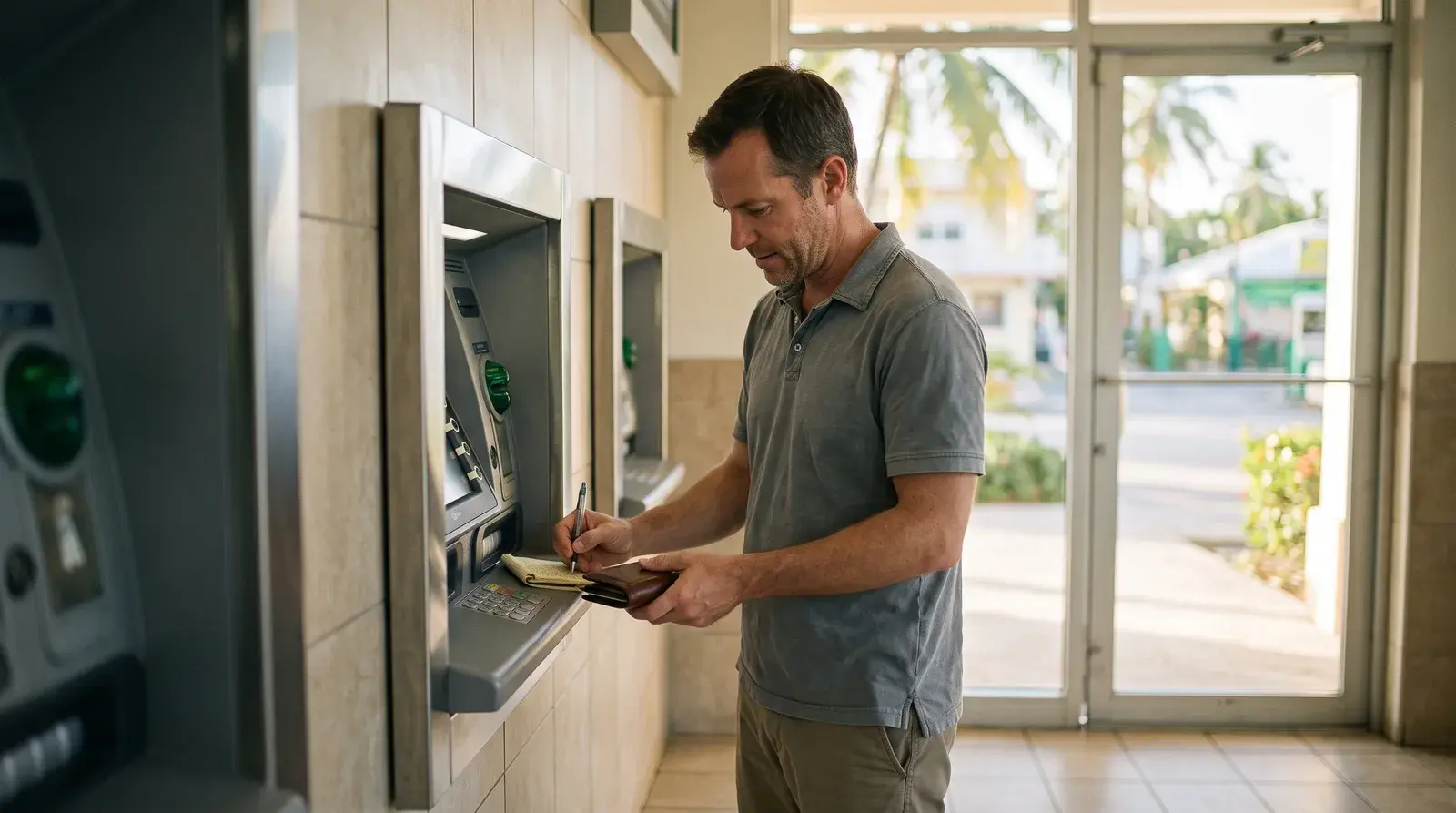
The first one is the easiest to handle, because the machine tells you. Panamanian banks set the foreign-card surcharge as an acquirer fee rather than as part of the customer tariff they publish, and the machine discloses it on screen before you confirm. You can read the exact charge for that ATM on that day, and decline right there if you do not like it. Try two machines on your first afternoon, note what each one asks, and use the cheaper one for the rest of your stay. Machines also state their per-withdrawal cap on the same screen, which is why we do not quote one.
The second charge is the one that actually decides your annual cost, and it is set by your own issuer. Ask them in writing what they charge for an international ATM withdrawal and whether they reimburse the local operator fee, then fewer, larger withdrawals will beat many small ones by simple arithmetic.
The third is where the dollar peg helps you, and only there. If your account is in dollars, there is no conversion and no spread. If your account is in sterling, euros or Canadian dollars, your own bank converts at its own rate. The peg removes Panamanian exchange risk. It does not remove your issuer's margin.
Sistema Clave: one network behind every machine
Sistema Clave, operated by Telered, is Panama's shared electronic payments network, connecting more than 2,000 ATMs and over two million cards across the licensed banks. That is why a Banco Nacional card works in a Banco General machine, and why the number that matters is your own bank's out-of-network charge rather than whose logo is on the box.
Network size still matters for the fee-free case. Banco General is the largest, with more than 619 ATMs and 76 branches, and it was founded in 1955 as the first private bank of Panamanian capital. If your bank charges nothing inside its own network, the biggest network is worth having.
One recent change worth knowing if you bank there. Banistmo changed hands in 2026: Banco La Hipotecaria, part of Inversiones Cuscatlán, closed its acquisition on 1 July 2026. Banistmo itself began in 1984 as Primer Banco del Istmo, was bought by HSBC in 2006, and was bought back and renamed by Bancolombia in 2013. Terms and fee schedules often move after an ownership change, so read the current tarifario before you assume anything carried over.
For what an account actually requires, see our guide to banking as a non-resident. For what you will actually spend once you are here, the cost of living guide works off census and government price data.
Do you need help finding a property in your budget?
Tell us roughly what you're working with and a licensed broker will come back with what it buys, where. No obligation, and nobody quotes you a price before you know the title status.
Email or phone, whichever you’d rather. We pass your details to one licensed broker and no one else, and there’s no newsletter.
Know your budget and timeline already? Send those instead and get a shortlist →
Dollars in your pocket, balboas in your change
Panama's currency arrangement is unusual and it explains most of the above. Ley 84 de 28 de junio de 1904 made the balboa the monetary unit and fixed it at one US dollar. Panama has issued balboa coins ever since and has never sustained a paper currency. A 1941 attempt at banknotes lasted about a week before the government that authorised it was removed.
So the notes circulating here are US dollars, and the coins are Panamanian, minted to US dimensions so they work in the same machines. Prices written B/.5 and $5 mean the same thing, and you will see both on the same menu. There is no central bank to devalue anything, which is the real reason a US card sees no exchange spread in Panama.
Cash you have to declare
This one carries a real penalty, and it catches people going the wrong way.
Panama requires a sworn declaration for cash, negotiable instruments or goods with a total value above B/.10,000, and it applies on the way out as well as on the way in. The instrument is the Declaración Jurada de Viajero, established by Resolución 297 of the Autoridad Nacional de Aduanas, part of Panama's FATF commitments. You state the amount, the currency or instrument, and where the money came from.
The outbound half is the one people miss, because most countries make more noise about arrivals. Aduanas does seize undeclared money, and it publicises the seizures. The form takes a few minutes and it is free.
Practical tips for your first week
- Choose your Panamanian bank on its fee schedule, not its ATM count. Sistema Clave connects them all, so the tarifario is the document that decides your costs.
- Do your first withdrawal at a machine you can walk away from, read the surcharge screen, and repeat at a second machine before settling on one.
- Carry small notes. Taxis, fondas and neighbourhood shops break a $20 far more happily than a $100.
- Keep some coins. Balboa coins and US coins circulate side by side and both work in parking meters and vending machines.
- If your home account is not in dollars, budget for your own bank's conversion rate rather than assuming the peg covers you.
- Declare anything over B/.10,000 in both directions. The obligation runs on exit as well as entry.
Your next step
Getting cash out of a machine is the easy part of moving money to Panama. The bigger questions come next: which bank will actually open an account for your residency status, how much to hold here against what you keep at home, and what a month really costs in the town you are looking at. We answer those for readers every week, with the same published sources we used above. Tell us where you are headed and roughly when, using the form below, and we will come back with the specifics for your situation.
Frequently asked questions
How much does it cost to use an ATM in Panama?
For a Panamanian account holder, published tarifarios put it between nothing and B/.1.87 per withdrawal including the 7% ITBMS. Banco Nacional charges B/.1.50 plus ITBMS at any ATM in the country, its own or another bank's. Banco General charges nothing inside its network and B/.1.75 plus ITBMS outside it, an increase it made on 15 January 2025. Banesco gives three free out-of-network withdrawals a month, then charges. For a card issued abroad the answer is different and no Panamanian bank publishes it: the machine discloses its surcharge on screen before you confirm.
Does Panama use the US dollar or the balboa?
Both, and the split is physical. The balboa has been fixed at one US dollar since Ley 84 de 28 de junio de 1904, but Panama has never sustained a paper currency, so the balboa circulates only as coins. Every banknote in circulation is a US dollar. Panama has no central bank. A 1941 attempt at balboa banknotes lasted about a week.
Will I pay an exchange-rate spread withdrawing cash in Panama?
Only if your account is not in US dollars. Because the balboa is pegged one to one and the notes are dollars, a dollar account converts nothing. A sterling, euro or Canadian dollar account is converted by your own bank at your own bank's rate, and Panama's peg does nothing to change that. The peg removes Panamanian exchange risk, not your issuer's margin.
Which Panamanian bank has the most ATMs?
Banco General, with more than 619 ATMs and 76 branches. It was founded in 1955 as the first private bank of Panamanian capital. That said, network size matters less than it sounds: Sistema Clave, run by Telered, is a shared network connecting more than 2,000 ATMs and over two million cards across the licensed banks, so most cards work in most machines. What varies is your own bank's charge for using a machine outside its network.
How much cash can I bring into Panama?
There is no limit on the amount, but anything above B/.10,000 in cash, negotiable instruments or goods must be declared on the Declaración Jurada de Viajero, established by Resolución 297 of the Autoridad Nacional de Aduanas. The requirement applies leaving Panama as well as entering, which is the half most travellers miss. You state the amount, the instrument and the origin of the funds. Aduanas seizes undeclared money and publicises the seizures.
Is it cheaper to withdraw money abroad using a Panamanian account?
No, considerably more expensive. Banco Nacional charges B/.10.00 plus ITBMS, so B/.10.70, for a withdrawal outside Panama. Banesco charges 3.21% of the amount with a minimum of $15, plus B/.5.00 for a balance enquiry abroad. Those are published figures in each bank's tarifario. A Panamanian account is for living here, not for travelling on.
Sources
- Banco Nacional de Panamá — Tabla de tarifas, cargos y comisiones (local ATM B/.1.50 + ITBMS; international B/.10.00 + ITBMS) — checked 2026-08-03
- Banco General — Tasas, comisiones y recargos — checked 2026-08-03
- Banco General — Aumento en el costo por retiros en cajeros de otros bancos, B/.1.75 + ITBMS effective 15 January 2025 — checked 2026-08-03
- Banesco Panamá — Tarifario local (own ATM free; other banks B/.1.50 after the third monthly withdrawal; abroad 3.21%, minimum $15) — checked 2026-08-03
- Telered — Sistema Clave, Panama's shared electronic payments and ATM network — checked 2026-08-03
- Banco General — Información corporativa (founded 1955, first private bank of Panamanian capital; 619+ ATMs, 76+ branches) — checked 2026-08-03
- Autoridad Nacional de Aduanas — Declaración Jurada de Viajero, Resolución 297, B/.10,000 threshold on entry and exit — checked 2026-08-03
- Superintendencia de Bancos de Panamá — Tarifario, the regulator's published rate comparison — checked 2026-08-03
- Instituto de Meteorología e Hidrología de Panamá — Descripción general del clima de Panamá (cited for the correction that Panama has no hurricane season) — checked 2026-08-03
Do you need help finding a property in your budget?
Tell us roughly what you're working with and a licensed broker will come back with what it buys, where. No obligation, and nobody quotes you a price before you know the title status.
Email or phone, whichever you’d rather. We pass your details to one licensed broker and no one else, and there’s no newsletter.
Know your budget and timeline already? Send those instead and get a shortlist →