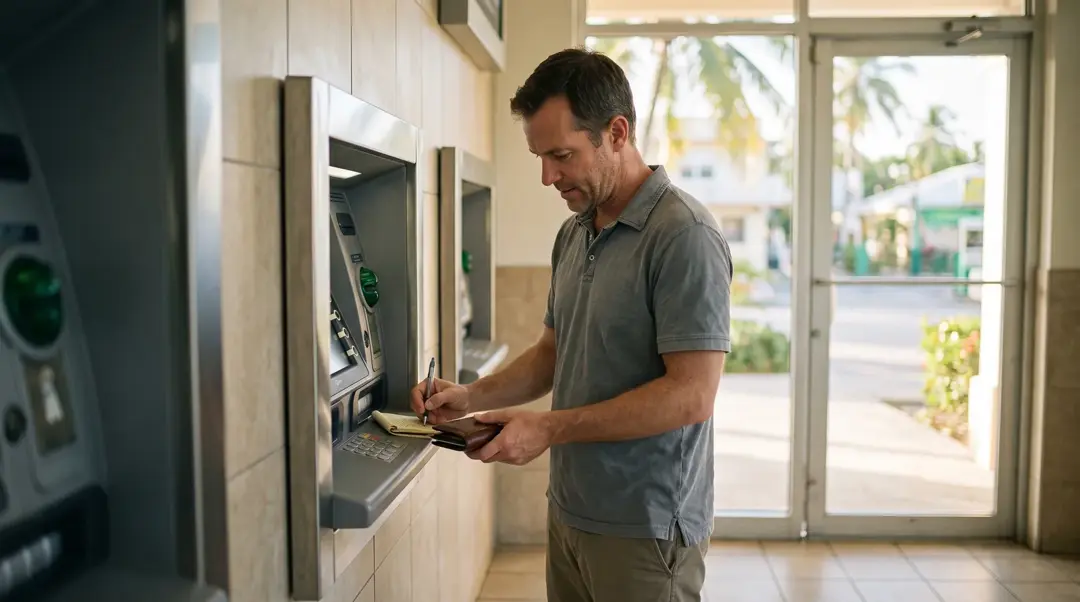
Here is the encouraging part, and it is the part most people get wrong before they arrive. Filing a Friendly Nations residency application costs B/.1,050 in government cheques, B/.250 to the Tesoro Nacional and B/.800 to the Servicio Nacional de Migración. Opening a bank account at Banco General costs $50 or $300 depending on the account tier. Your furniture comes in tax-free up to B/.25,000. Those are the three costs people most often budget four or five figures too high, and all three are published by the institution that charges them.
So what does the whole move actually come to? Below is the full line-item table with a source against every row, and then a worked example that adds those specific rows up for two common ways of arriving. Two items genuinely move the total, container shipping and rent, and you will see exactly where they sit in the sum rather than buried inside a rounded headline number.
Key takeaways
- Friendly Nations residency clears with two government cheques totaling B/.1,050 (B/.250 to the Tesoro Nacional, B/.800 to Migración), on top of the B/.200,000 property or fixed-deposit threshold, which is capital you place rather than money you spend. Servicio Nacional de Migración, PPT-PE requirement sheet, checked August 2026.
- Household goods come in tax-free up to B/.25,000 for any new resident, with a separate B/.10,000 pensionado allowance that Article 9 of its own law closes to immigrant-visa holders. Decreto de Gabinete 41 de 2002, art. 216; Ley 9 de 1987, arts. 2 and 9.
- A bank account opens at $50 or $300, per Banco General's own published account pages, checked August 2026. The paperwork is the hurdle, not the deposit.
- CSS voluntary health insurance costs a minimum of $110 a month, and none of the three residency permits most buyers and retirees use requires proof of insurance at all. Caja de Seguro Social, Reglamento General de Afiliación e Inscripción, checked August 2026.
- A 20-foot container runs $2,000 to $3,000 door to door and a 40-foot container $3,000 to $4,200, per one freight forwarder's own published rate page, disclosed as a commercial quote rather than an official rate.
- Median monthly rent in Provincia de Panamá is B/.300, with 9,684 homes in the province renting at B/.1,000 or more. INEC, 2023 census. Those two figures bracket almost every arrival budget.
The line items, with a source against each
| Line item | Figure | Source |
|---|---|---|
| Friendly Nations government cheques | B/.1,050 (B/.250 + B/.800) | Migración PPT-PE sheet |
| Friendly Nations property or deposit threshold | B/.200,000 | Migración PPT-PE sheet |
| Pensionado income requirement | B/.1,000/month lifetime pension, no capital | Migración PRP-JP sheet, Art. 200 |
| Household goods exemption, general | Up to B/.25,000, tax-free | Decreto de Gabinete 41 de 2002, art. 216 |
| Household goods exemption, pensionado | Up to B/.10,000, tariff only, excluded for immigrant-visa holders | Ley 9 de 1987, arts. 2, 9 |
| Container shipping, 20ft / 40ft, door to door | $2,000–$3,000 / $3,000–$4,200 | One freight forwarder's own published rate |
| Median rent, Provincia de Panamá | B/.300/month | INEC 2023 census |
| Rented homes in the province at B/.1,000+/month | 9,684 | INEC 2023 census |
| Rental security deposit (statutory) | 1 month's rent, held in trust | Ley 93 de 1973, art. 13 |
| Bank account minimum deposit | $50–$300 (Banco General) | Bgeneral.com |
| CSS voluntary health insurance | $110/month minimum, not required for residency | CSS Reglamento |
| Tourist entry (US/Canada/UK) | $0, passport stamp, 180 days for US/Canada | Resolución 22068 de 2021 |
| Visa de Turista (where required) | B/.50 government fee + B/.500 solvency proof (not spent) | Migración Visa de Turista sheet |
| Immigration attorney fees | Quoted privately, no published schedule | Get it in writing |
The worked example: what those rows add up to
Take a couple applying through Friendly Nations, renting on arrival in Panama City. Every figure below is a row from the table above. Nothing new is introduced.
Arriving with suitcases. Government cheques B/.1,050. A Banco General Cuenta Corriente Regular at $300. First month's rent plus the statutory one-month deposit under Ley 93, Article 13, which at the B/.1,000 census band is B/.2,000. That comes to B/.3,350 before you buy a stick of furniture. Rent at the provincial median of B/.300 instead and the housing pair drops to B/.600, taking the same arrival to B/.1,950.
Arriving with a 20-foot container. The same B/.3,350, plus $2,000 to $3,000 for the shipment, so B/.5,350 to B/.6,350, with the household goods themselves entering tax-free under the B/.25,000 exemption. Step up to a 40-foot container at $3,000 to $4,200 and the same arrival lands at B/.6,350 to B/.7,550.
If you want CSS cover from month one, add $110 a month on top. None of the three residency routes requires it, so treat it as a choice rather than a line item.
Two things move that total, and it is worth being clear about which. Shipping is the first: the range above is one forwarder's published pricing, and fuel, season and route all move it, so quote your own before you budget. Rent is the second, and it is the bigger lever by far, because the gap between the B/.300 census median and the B/.1,000 band is the difference between the two totals above and most of the difference in your first year. On top of both sits your attorney's fee, which is quoted case by case rather than published, so ask for it in writing and ask specifically whether it includes the government cheques, translation, and the second Friendly Nations filing at the end of the two-year provisional permit.
What the worked example deliberately does not include is the B/.200,000 Friendly Nations threshold, because that is capital placed in property or a fixed deposit, not money spent. Choose Pensionado instead and there is no capital requirement at all, only the B/.1,000 monthly lifetime pension.
Residency: what you pay to qualify, not what you own
Our residency guide sets out three routes, and the cost of each is mostly a threshold rather than a fee. Pensionado asks for a lifetime pension of at least B/.1,000 a month, plus B/.250 per dependent, and no property or deposit at all. Friendly Nations asks for B/.200,000 in property, which can be bank-financed, or a B/.200,000 fixed-term deposit free of liens. Qualified Investor asks for B/.300,000 in property free of liens, B/.500,000 in securities held five years, or a B/.750,000 fixed deposit held five years.
What actually leaves your pocket is smaller and more specific: the two certified cheques of B/.250 and B/.800 that go in with a Friendly Nations application. If a bank deposit does the job as well as a purchase for your situation, the deposit route carries no maintenance, HOA, tenant or resale exposure, and the residency guide compares the two side by side.
Immigration legal fees sit outside all of this and are quoted case by case. Get a written quote that itemises what it covers, since Friendly Nations involves two filings rather than one: a two-year provisional permit first, then permanence as a separate application.
Household goods: the exemption is generous, the freight is the variable
Our moving guide traces the customs benefit to Article 216 of Decreto de Gabinete 41 de 2002: any foreigner proving they are establishing domicile in Panama may bring in up to B/.25,000 of used household goods with no import tax. That is the general regime, and it is the larger one. The pensionado-specific benefit under Ley 9 de 1987 caps at B/.10,000 and relieves only the tariff.
One detail worth raising with your attorney before you book: Article 9 of Ley 9 excludes anyone granted an immigrant visa from claiming its benefits, which reads as closing the smaller pensionado allowance to the property-based residency routes. Confirm which regime your specific permit qualifies for.
On the shipment itself, the figure this page can point to is Interworld Freight's own published rate page: an average $2,000 to $3,000 for a 20-foot container and $3,000 to $4,200 for a 40-foot container to Panama, door to door, checked August 2026. That is one company's current quote rather than a market average. Get two or three of your own.
A generous exemption is not by itself a reason to fill a container. Leather, books and softwood furniture bought for a dry climate have a hard time in a humid one, a large share of rentals here come furnished, and a documentation error leaves a container accruing port storage by the day. Ship what you would genuinely miss, buy the rest here, and the shipping row drops out of your total entirely.
Do you need help finding a property in your budget?
Tell us roughly what you're working with and a licensed broker will come back with what it buys, where. No obligation, and nobody quotes you a price before you know the title status.
Email or phone, whichever you’d rather. We pass your details to one licensed broker and no one else, and there’s no newsletter.
Know your budget and timeline already? Send those instead and get a shortlist →
Housing: the single biggest lever in your budget
Our cost of living guide reads the 2023 national census directly: median monthly rent for an occupied rented home in Provincia de Panamá is B/.300, and nationally it is B/.200. In the same province, 9,684 of 90,562 rented homes, 10.7%, rent at B/.1,000 or more. That upper band is where furnished, foreigner-standard apartments in the capital sit, which is why the worked example above uses it, and it is also why your own total is mostly a housing decision.
On the deposit, our apartments guide traces the statutory mechanism: Ley 93 de 1973, Article 13, sets the security deposit at one month's rent, held in trust at a state bank rather than in the landlord's own account. That article survives a 1994 decree excluding most of the rest of the rental law above B/.150 a month, so it applies to a market-rate apartment too. Ask your landlord whether the deposit will be filed under Article 13 and get the answer in writing.
Some landlords will ask for more up front than one month plus a deposit. There is no published rule setting that, so treat it as a term to negotiate rather than a fixed cost, and budget the possibility without assuming it.
Banking: what it actually costs to open an account
Our banking guide reads Banco General's own account pages, since it is the bank whose requirements for a foreign applicant are published most clearly. Cuenta Corriente Esencial opens at $50; Cuenta Corriente Regular opens at $300.
The real work is documentary rather than financial: a passport or permanent residency card, proof of income, and what the bank calls a vínculo con Panamá, a link to Panama, which its public page does not itemise. Budget the time to gather that rather than the deposit. If a specific bank quotes you a four-figure opening minimum, ask which account tier it applies to, because tiers differ.
Health coverage: what CSS costs, and whether you need it
Our healthcare guide sources this from the Caja de Seguro Social's own affiliation regulation: a foreign national enrolling in CSS voluntary insurance pays a minimum of $110 a month, calculated as 22% of a declared income on a $500 minimum base, bundled with a pension contribution you cannot buy separately.
The useful fact for your budget is what CSS enrollment is not. None of the three residency permits most buyers and retirees use, Pensionado, Rentista Retirado, or Friendly Nations by real estate, requires proof of health insurance. Their requirement sheets ask for a Certificado de Salud, a medical checkup, not a policy. A foreigner already past CSS pension eligibility age, 57 for women and 62 for men, generally cannot newly enroll in the voluntary regime. Private international insurance and CSS are both real options with different costs and eligibility rules, and the healthcare guide compares them so you can decide deliberately instead of buying a policy your application never asked for.
Getting here before residency is granted
Most readers of this site, nationals of the United States, Canada and the United Kingdom, enter Panama as tourists with no visa and no fee: a passport stamp at the airport. US and Canadian citizens get 180 days on that stamp, not the 90 often assumed, under Resolución 22068 de 2021.
A smaller group of nationalities needs a Visa de Turista before travel. Migración's requirement sheet lists a B/.50 payment for migratory services filed with the application, plus proof of at least B/.500 in economic solvency, which is evidence of funds shown through a bank or credit card statement and stays yours. Servicio Nacional de Migración, Requisitos para Solicitar Visa de Turista, Article 16, checked August 2026.
Which version of this move is yours
- Renting first, suitcases only, Pensionado income already in place: the cheapest arrival on this page, around B/.1,950 to B/.3,350 depending on the rent band, with no capital threshold at all.
- Buying to qualify through Friendly Nations: the same arrival costs plus B/.200,000 placed in property. Start with the residency guide, then the cost of living guide for the ongoing side.
- Bringing a household: add the container row, confirm your exemption regime with an attorney first, and read the moving guide before you book the forwarder.
- Not sure which town yet: rent through a rainy season before committing capital. Our apartments guide covers the lease mechanics.
Your next step
The numbers above will get you within striking distance of your own total. What they can't tell you is which route fits your income, which neighbourhood fits your rent band, or what a real apartment at that price looks like this month. Send us your budget, your timeline, and a sentence about your situation, whether that is a pension, a purchase, or a container in a garage somewhere. We will come back with a shortlist: the residency route that fits, the areas that match your number, and actual properties to look at. It costs nothing to ask, and the form below is the whole of it.
Frequently asked questions
What is the total realistic cost of moving to Panama?
Built from the sourced line items on this page, a couple applying through Friendly Nations and renting on arrival in Panama City comes to about B/.3,350 arriving with suitcases: B/.1,050 in government cheques, a $300 bank account opening, and first month plus a one-month statutory deposit at the B/.1,000 census rent band. Rent at the B/.300 provincial median instead and it falls to roughly B/.1,950. Add $2,000 to $3,000 for a 20-foot container, or $3,000 to $4,200 for a 40-foot one. Your attorney's fee is quoted case by case, and the B/.200,000 Friendly Nations threshold is capital placed, not spent.
How much does residency in Panama actually cost?
Pensionado requires no property or deposit at all, only a lifetime pension of at least B/.1,000 a month. Friendly Nations requires B/.200,000 in property or a fixed deposit, plus B/.1,050 in government filing cheques (B/.250 to the Tesoro Nacional and B/.800 to Migración). Qualified Investor requires B/.300,000 in property, B/.500,000 in securities, or a B/.750,000 deposit. Immigration attorney fees are quoted case by case on top, so get yours in writing.
Do I have to pay import tax on my furniture when I move to Panama?
No, up to a limit. Any foreigner who can prove they are establishing domicile in Panama may import up to B/.25,000 of used household goods with no tax under Decreto de Gabinete 41 de 2002. A separate, smaller pensionado benefit caps at B/.10,000 and relieves only the tariff, and Article 9 of the law behind it excludes anyone holding an immigrant visa, including most property-based residency routes, from that smaller benefit. Confirm which regime your permit qualifies for before booking a shipment.
How much does it cost to ship a container to Panama?
One freight forwarder's own published rate page quotes an average $2,000 to $3,000 for a 20-foot container and $3,000 to $4,200 for a 40-foot container, door to door, checked August 2026. That is a commercial quote rather than an official rate, and it moves with fuel, season and route, so get two or three of your own before budgeting. The goods themselves come in tax-free up to the B/.25,000 exemption.
How much money do I need to open a Panama bank account?
Banco General, the bank whose requirements are published most clearly for foreign applicants, lists a $50 minimum for its Esencial current account and $300 for its Regular account. The bigger hurdle is documentary: a passport or residency card, proof of income, and a demonstrable link to Panama, which the bank's page does not itemise in detail. Budget the time rather than the deposit.
Is health insurance required to get residency in Panama?
No. None of the three residency permits most buyers and retirees use, Pensionado, Rentista Retirado, or Friendly Nations by real estate, requires proof of health insurance; their requirement sheets ask for a medical checkup certificate instead. If you want coverage anyway, Panama's Caja de Seguro Social offers voluntary insurance for foreigners from a minimum of $110 a month, bundled with a pension contribution you cannot buy separately.
Do I need a visa just to visit Panama before I apply for residency?
Most readers of this site, nationals of the US, Canada and the UK among others, enter Panama as tourists with no visa and no fee, just a passport stamp. US and Canadian citizens get 180 days on that stamp. A smaller list of nationalities needs a Visa de Turista before travel, which carries a B/.50 government fee plus proof of at least B/.500 in funds, which is shown rather than spent.
How much rent should I budget for in Panama City?
The 2023 census puts median monthly rent in Provincia de Panamá at B/.300, and counts 9,684 of the province's 90,562 rented homes at B/.1,000 or more. Furnished, foreigner-standard apartments in the capital sit in that upper band, which is why it anchors the worked example on this page. Rent is the single biggest lever in a moving budget, so pinning your band down first settles most of your total.
Sources
- Servicio Nacional de Migración — Requisitos para Jubilado Pensionado (PRP-JP) — checked 2026-08-02
- Servicio Nacional de Migración — Países Específicos, relaciones amistosas (PPT-PE / PPP-PE) — checked 2026-08-02
- Decreto Ejecutivo No. 193 de 15 de octubre de 2024 (Inversionista Calificado), Gaceta Oficial 30140-B — checked 2026-08-02
- Servicio Nacional de Migración — Requisitos para Solicitar Visa de Turista, Art. 16 (B/.50 migratory-services fee, B/.500 solvency proof) — checked 2026-08-03
- Decreto de Gabinete 41 de 11 de diciembre de 2002, art. 216 (menaje de casa) — Gaceta Oficial 24,700 — checked 2026-08-02
- Ley 9 de 24 de junio de 1987, exenciones a jubilados y pensionados — checked 2026-08-02
- Ley 93 de 4 de octubre de 1973 (Ley de Arrendamientos), Artículo 13 — mecanismo del depósito en fideicomiso — checked 2026-08-03
- INEC — XII Censo Nacional de Población y VIII de Vivienda 2023, Cuadro 8: viviendas alquiladas por monto del alquiler mensual — checked 2026-08-02
- Banco General — Cuenta Corriente Esencial ($50 minimum) and Regular ($300 minimum), documentation requirements for new foreign customers — checked 2026-08-03
- Caja de Seguro Social — Reglamento General de Afiliación e Inscripción (Grupo B.2, aseguramiento voluntario de extranjeros, $110 mínimo) — checked 2026-08-03
- Interworld Freight — Shipping container rates to Panama, 20ft $2,000–$3,000 and 40ft $3,000–$4,200 (one forwarder's own published rate, not an institutional figure) — checked 2026-08-03
Do you need help finding a property in your budget?
Tell us roughly what you're working with and a licensed broker will come back with what it buys, where. No obligation, and nobody quotes you a price before you know the title status.
Email or phone, whichever you’d rather. We pass your details to one licensed broker and no one else, and there’s no newsletter.
Know your budget and timeline already? Send those instead and get a shortlist →